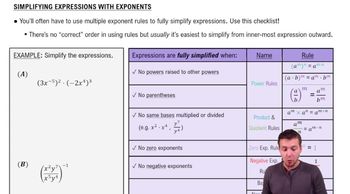
The power rule states that when raising a power to another power, you multiply the exponents.
How do you simplify an expression like (x^a)^b?
You multiply the exponents: (x^a)^b = x^(a*b).
What is the product rule for exponents?
The product rule states that when multiplying like bases, you add the exponents.
How do you simplify x^m * x^n?
You add the exponents: x^m * x^n = x^(m+n).
What is the quotient rule for exponents?
The quotient rule states that when dividing like bases, you subtract the exponents.
How do you simplify x^m / x^n?
You subtract the exponents: x^m / x^n = x^(m-n).
How do you handle negative exponents in an expression?
Rewrite negative exponents as reciprocals to make all exponents positive.
What happens to x^-a in an expression?
x^-a becomes 1/x^a.
What should you do with numerical coefficients that have exponents?
Evaluate the numerical coefficients by performing the exponent operation.
How do you simplify (3x^-5)^2?
Distribute the exponent: 3^2 = 9 and x^-5^2 = x^-10, so the expression becomes 9x^-10.
What is the best order to simplify multivariable polynomials with exponents?
Work from the innermost parentheses outward, simplifying step-by-step.
How do you simplify x^2y^7 / x^5y^4?
Apply the quotient rule: x^2/x^5 = x^-3 and y^7/y^4 = y^3, so the expression is x^-3y^3.
What should you do if an entire expression is raised to a negative exponent?
Take the reciprocal of the expression and change the exponent to positive.
How do you simplify (x^-3y^3)^-1?
Distribute the -1 exponent: x^-3^-1 = x^3 and y^3^-1 = y^-3, so the expression is x^3/y^3.
What is the final checklist for a fully simplified exponential expression?
Ensure there are no parentheses, no powers on powers, no same bases multiplied or divided, no zero or negative exponents, and all numbers are evaluated.