Back

Simplifying Expressions definitions

Control buttons has been changed to "navigation" mode.
1/15
  • Algebraic Expression

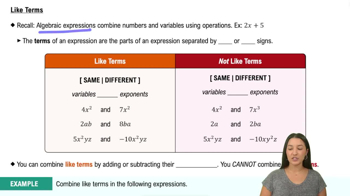
    A mathematical phrase combining numbers and variables using operations, without an equals sign.
  • Term

    A part of an expression separated by plus or minus signs, which may include numbers, variables, or both.
  • Like Terms

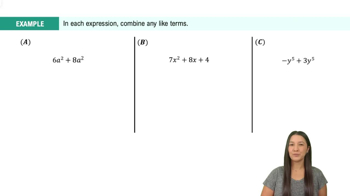
    Parts of an expression with identical variables raised to the same exponents, allowing their coefficients to be combined.
  • Unlike Terms

    Parts of an expression with different variables or exponents, preventing their coefficients from being combined.
  • Variable

    A symbol, often a letter, representing an unknown or changeable value in an expression.
  • Coefficient

    A numerical factor multiplying a variable or variables in a term.
  • Exponent

    A small number written above and to the right of a variable, indicating how many times the variable is used as a factor.
  • Constant

    A term in an expression that contains only a number, with no variables.
  • Parentheses

    Curved symbols used to group parts of an expression, indicating operations to perform first.
  • Distribution

    The process of multiplying a term outside parentheses by each term inside the parentheses.
  • Simplified Expression

    A form of an expression with no parentheses and all like terms combined.
  • Grouping

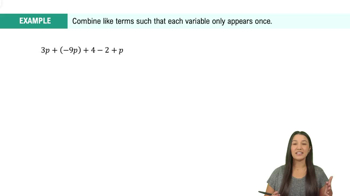
    Arranging like terms next to each other to make combining their coefficients easier.
  • Polynomial

    An expression made up of the sum or difference of terms, each consisting of variables raised to whole-number exponents and coefficients.
  • Operation

    A mathematical action such as addition, subtraction, multiplication, or division used within expressions.
  • Coefficient Addition

    The process of adding or subtracting the numerical factors of like terms to combine them.