Skip to main content
Beginning Algebra
My Course
Learn
Exam Prep
AI Tutor
Study Guides
Flashcards
Try the app
My Course
Learn
Exam Prep
AI Tutor
Study Guides
Flashcards
Try the app
Back
Simplifying Fractions definitions
You can tap to flip the card.
Fraction
You can tap to flip the card.
👆
Fraction
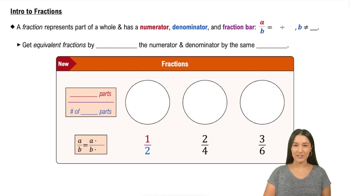
A numerical expression showing parts of a whole, using a numerator, denominator, and a fraction bar.
Track progress
Control buttons has been changed to "navigation" mode.
1/14
Related flashcards
Related practice
Recommended videos
Simplifying Fractions quiz
Simplifying Fractions
15 Terms
Simplifying Fractions
1. Review of Real Numbers
5 problems
Topic
ZacharyFrye
Evaluating Exponents
1. Review of Real Numbers
5 problems
Topic
ZacharyFrye
1. Review of Real Numbers - Part 1 of 2
4 topics
12 problems
Chapter
ZacharyFrye
1. Review of Real Numbers - Part 2 of 2
3 topics
9 problems
Chapter
AllySteele
Guided course
05:07
Intro to Fractions
1536
views
61
rank
Guided course
05:25
Types of Fractions
598
views
41
rank
Guided course
03:42
Intro to Fractions Example 1
458
views
33
rank
Terms in this set (14)
Hide definitions
Fraction
A numerical expression showing parts of a whole, using a numerator, denominator, and a fraction bar.
Numerator
The top value in a fraction, indicating how many parts are considered out of the whole.
Denominator
The bottom value in a fraction, showing into how many equal parts the whole is divided.
Fraction Bar
A horizontal line separating the numerator and denominator, representing division.
Equivalent Fractions
Different fractions that represent the same value, created by multiplying or dividing both parts by the same number.
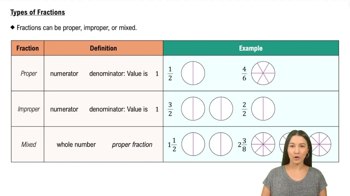
Proper Fraction
A fraction where the numerator is less than the denominator, always representing a value less than one.
Improper Fraction
A fraction with a numerator greater than or equal to the denominator, always at least one or more.
Mixed Number
A number combining a whole number and a proper fraction, such as one and one-half.
Lowest Terms
A fraction form where numerator and denominator share no common factors except one.
Greatest Common Factor
The largest number that divides both the numerator and denominator without a remainder.
Prime Factor
A factor of a number that is a prime number, used to break down numbers for simplification.
Division
The mathematical operation represented by a fraction, splitting a quantity into equal parts.
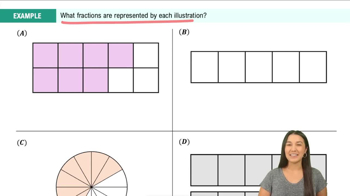
Visual Representation
A diagram, often using shapes, to illustrate the value of a fraction by shading parts of a whole.
Common Factor
A number that divides both the numerator and denominator evenly, used in simplifying fractions.
 BackBack

 05:07
05:07