Back

Simplifying Rational Expressions definitions

Control buttons has been changed to "navigation" mode.
1/15
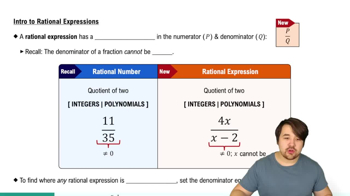
  • Rational Expression

    A quotient where both the numerator and denominator are polynomials, similar to a fraction with variables.
  • Polynomial

    An algebraic sum involving numbers and variables raised to whole number exponents, combined using addition or subtraction.
  • Numerator

    The top part of a rational expression, representing the dividend in the division of polynomials.
  • Denominator

    The bottom part of a rational expression, indicating the divisor and determining where the expression is undefined.
  • Undefined Value

    An input that makes the denominator zero, causing the rational expression to have no valid result.
  • Common Factor

    A quantity present in both the numerator and denominator that can be canceled to simplify the expression.
  • Factoring

    The process of rewriting a polynomial as a product of simpler expressions, often to reveal common factors.
  • Simplest Form

    A state where all common factors between numerator and denominator are canceled, leaving no further reduction possible.
  • Monomial

    A single term consisting of a number, a variable, or their product, such as 3x or 7.
  • Binomial

    An algebraic expression with exactly two terms, typically joined by addition or subtraction.
  • Coefficient

    A numerical factor multiplying a variable within a term of a polynomial.
  • Exponent

    A small raised number indicating how many times a variable is multiplied by itself.
  • Conjugate

    A pair of binomials with identical terms but opposite signs between them, such as a + b and a - b.
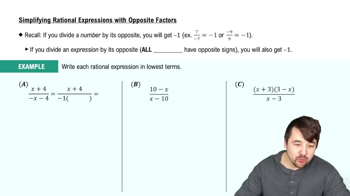
  • Opposite Factors

    Two expressions where every term has the opposite sign, resulting in a quotient of negative one when divided.
  • Greatest Common Factor

    The largest expression that divides each term of a polynomial, useful for factoring and simplifying.