Skip to main content
Beginning Algebra
My Course
Learn
Exam Prep
AI Tutor
Study Guides
Flashcards
Try the app
My Course
Learn
Exam Prep
AI Tutor
Study Guides
Flashcards
Try the app
Back
Solving Systems of Linear Equations by Elimination definitions
You can tap to flip the card.
Elimination Method
You can tap to flip the card.
👆
Elimination Method
A technique for solving systems by adding equations to remove a variable, often after adjusting coefficients to be equal and opposite.
Track progress
Control buttons has been changed to "navigation" mode.
1/15
Related flashcards
Related practice
Recommended videos
Solving Systems of Linear Equations by Elimination quiz
Solving Systems of Linear Equations by Elimination
15 Terms
Solving Systems of Linear Equations by Elimination
5. Systems of Linear Equations
5 problems
Topic
AllySteele
Systems of Linear Inequalities
5. Systems of Linear Equations
5 problems
Topic
JustinRaimundo
5. Systems of Linear Equations
4 topics
12 problems
Chapter
ErnestBlazevic
Guided course
04:04
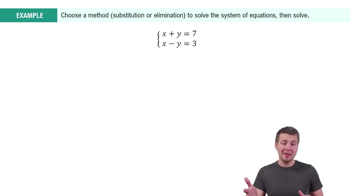
Choosing a Method to Solve a System Example 3
94
views
1
rank
Guided course
01:57
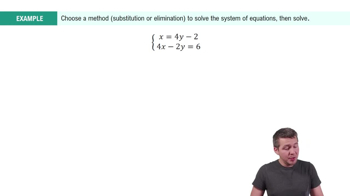
Choosing a Method to Solve a System Example 4
102
views
2
rank
Guided course
4:32
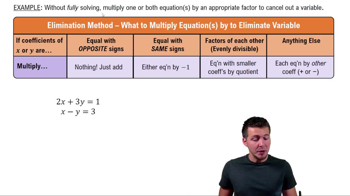
How to Multiply Equations in Elimination Method Example 1
87
views
1
rank
Terms in this set (15)
Hide definitions
Elimination Method
A technique for solving systems by adding equations to remove a variable, often after adjusting coefficients to be equal and opposite.
System of Linear Equations
A set of two or more equations with the same variables, where solutions satisfy all equations simultaneously.
Standard Form
An arrangement of equations as ax + by = c, aligning variables and constants vertically for easier manipulation.
Coefficient
A numerical factor multiplying a variable, crucial for aligning and eliminating variables in equations.
Variable
A symbol, often x or y, representing unknown values to be determined in equations.
Constant
A fixed value in an equation, not multiplied by a variable, typically found on the right side of standard form.
Opposite Sign
A pair of numbers with identical values but different signs, such as 3 and -3, used to cancel variables.
Multiples
Numbers obtained by multiplying a value by integers, used to align coefficients for elimination.
Substitution Method
A process where one variable is isolated and replaced in another equation to simplify solving.
Trial and Error
A strategy involving testing different multipliers to achieve equal and opposite coefficients for elimination.
Isolated Variable
A variable expressed alone on one side of an equation, making substitution straightforward.
True Statement
An equation that holds valid when solution values are substituted, confirming correctness.
Vertical Alignment
The arrangement of equations so that like terms are stacked, facilitating addition or subtraction.
Factor
A number that divides another exactly, used to determine suitable multipliers for coefficients.
Solution Pair
A set of values for variables that satisfy all equations in a system.
 BackBack


 04:04
04:04