Skip to main content
Beginning Algebra
My Course
Learn
Exam Prep
AI Tutor
Study Guides
Flashcards
Try the app
My Course
Learn
Exam Prep
AI Tutor
Study Guides
Flashcards
Try the app
Back
Solving Systems of Linear Equations by Elimination quiz
You can tap to flip the card.
What is the main goal of the elimination method when solving systems of linear equations?
You can tap to flip the card.
👆
What is the main goal of the elimination method when solving systems of linear equations?
The main goal is to add or subtract equations to eliminate one variable, making the system easier to solve.
Track progress
Control buttons has been changed to "navigation" mode.
1/15
Related flashcards
Related practice
Recommended videos
Solving Systems of Linear Equations by Elimination definitions
Solving Systems of Linear Equations by Elimination
15 Terms
Solving Systems of Linear Equations by Elimination
5. Systems of Linear Equations
5 problems
Topic
AllySteele
Systems of Linear Inequalities
5. Systems of Linear Equations
5 problems
Topic
JustinRaimundo
5. Systems of Linear Equations
4 topics
12 problems
Chapter
ErnestBlazevic
Guided course
04:04
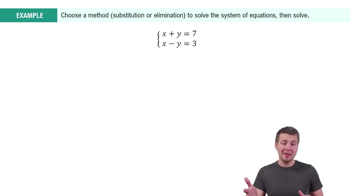
Choosing a Method to Solve a System Example 3
94
views
1
rank
Guided course
01:57
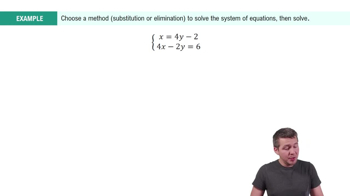
Choosing a Method to Solve a System Example 4
102
views
2
rank
Guided course
4:32
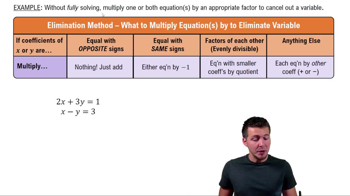
How to Multiply Equations in Elimination Method Example 1
87
views
1
rank
Terms in this set (15)
Hide definitions
What is the main goal of the elimination method when solving systems of linear equations?
The main goal is to add or subtract equations to eliminate one variable, making the system easier to solve.
Why must equations be written in standard form before using the elimination method?
Equations must be in standard form so that like terms (x, y, and constants) are aligned vertically for easy addition or subtraction.
What does it mean for coefficients to be 'equal and opposite' in the context of elimination?
It means the coefficients of a variable in both equations are the same number but with opposite signs, so they cancel when added.
What should you do if the coefficients of a variable are not equal and opposite?
You should multiply one or both equations by a constant to make the coefficients equal and opposite.
After eliminating one variable using elimination, what is the next step?
Solve the resulting single-variable equation, then substitute that value back into one of the original equations to find the other variable.
When is it unnecessary to multiply either equation before adding them in elimination?
When the coefficients of a variable are already equal and opposite, you can add the equations directly.
What should you do if the coefficients of a variable are equal but have the same sign?
Multiply one of the equations by -1 to make the coefficients equal and opposite.
How do you handle coefficients that are factors of each other in elimination?
Multiply the equation with the smaller coefficient by the appropriate factor (possibly with a negative sign) to match the larger coefficient.
What is a surefire method if none of the coefficients are equal, opposite, or factors of each other?
Multiply each equation by the other equation's coefficient for the variable you want to eliminate, adjusting signs as needed.
Why is elimination often preferred when both equations are in standard form?
Because the variables and constants are already aligned, making it easier to add or subtract the equations to eliminate a variable.
What is the standard form of a linear equation?
Standard form is ax + by = c, where a, b, and c are constants.
What should you check before choosing the elimination method?
Check if both equations are in standard form and if any coefficients are the same, opposite, or multiples of each other.
When might substitution be a better method than elimination?
When one variable is already isolated or has a coefficient of 1 or -1, making substitution straightforward.
What is the final step after finding values for both variables in a system?
Check your solution by substituting both values into the original equations to ensure they make both equations true.
What is a common sign that elimination is the more convenient method to use?
When both equations are in standard form and neither variable is isolated, especially if coefficients are multiples of each other.
 BackBack


 04:04
04:04