Skip to main content
Beginning Algebra
My Course
Learn
Exam Prep
AI Tutor
Study Guides
Flashcards
Try the app
My Course
Learn
Exam Prep
AI Tutor
Study Guides
Flashcards
Try the app
Back
Solving Systems of Linear Equations by Graphing definitions
You can tap to flip the card.
System of Equations
You can tap to flip the card.
👆
System of Equations
A set of two or more equations with the same variables, analyzed together to find shared solutions.
Track progress
Control buttons has been changed to "navigation" mode.
1/15
Related flashcards
Related practice
Recommended videos
Solving Systems of Linear Equations by Graphing quiz
Solving Systems of Linear Equations by Graphing
15 Terms
Solving Systems of Linear Equations by Graphing
5. Systems of Linear Equations
5 problems
Topic
ErnestBlazevic
Solving Systems of Linear Equations by Substitution
5. Systems of Linear Equations
5 problems
Topic
AllySteele
5. Systems of Linear Equations
4 topics
12 problems
Chapter
ErnestBlazevic
Guided course
3:31
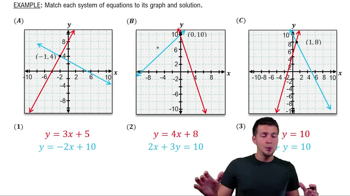
Solve a System of Linear Equations by Graphing Example 3
86
views
1
rank
Guided course
3:09
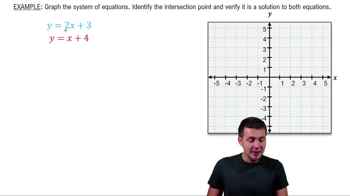
Solve a System of Linear Equations by Graphing Example 1
97
views
3
rank
Guided course
04:42
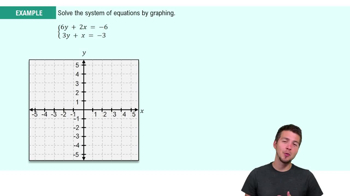
Solve a System of Linear Equations by Graphing Example 2
93
views
2
rank
Terms in this set (15)
Hide definitions
System of Equations
A set of two or more equations with the same variables, analyzed together to find shared solutions.
Linear Equation
An equation whose graph forms a straight line, typically written in the form y = mx + b.
Slope-Intercept Form
A way to write equations as y = mx + b, making it easy to identify slope and y-intercept for graphing.
Standard Form
An equation format written as Ax + By = C, often converted to y = mx + b for graphing.
Slope
A measure of a line’s steepness, calculated as the change in y divided by the change in x.
Y-Intercept
The point where a line crosses the y-axis, indicating the value of y when x is zero.
Intersection Point
The coordinate where two lines cross, representing the solution to a system if it exists.
Parallel Lines
Lines with identical slopes but different y-intercepts, never meeting and yielding no shared solutions.
Consistent System
A system with at least one solution, meaning the equations are not contradictory.
Inconsistent System
A system with no solutions, often due to parallel lines that never intersect.
Independent System
A system where equations represent different lines, typically intersecting at a single point.
Dependent System
A system where equations describe the same line, resulting in infinitely many solutions.
Solution
A coordinate pair that satisfies all equations in a system, found at the intersection of their graphs.
Substitution
A method for checking solutions by plugging values into equations to verify true statements.
Coordinate Pair
An ordered pair (x, y) representing a point on the graph, used to test or express solutions.
 BackBack

 3:31
3:31