Beginning Algebra
My Course
Learn
AI Tutor
Study Guides
Flashcards
Try the app
My Course
Learn
AI Tutor
Study Guides
Flashcards
Try the app
Back
The Quadratic Formula quiz
You can tap to flip the card.
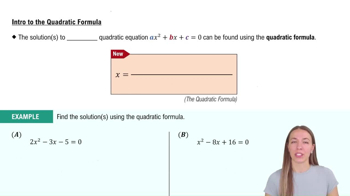
What is the quadratic formula used to solve any quadratic equation in standard form?
You can tap to flip the card.
👆
What is the quadratic formula used to solve any quadratic equation in standard form?
The quadratic formula is x = -b ± √(b² - 4ac) / (2a), where a, b, and c are the coefficients of the equation.
Track progress
Control buttons has been changed to "navigation" mode.
1/15
Related flashcards
Recommended videos
The Quadratic Formula definitions
The Quadratic Formula
15 Terms
Guided course
04:11
The Discriminant
33
views
1
rank
03:45
Choosing a Method to Solve Quadratic Equations
30
views
06:08
Introduction to the Quadratic Formula
59
views
3
rank
Terms in this set (15)
Hide definitions
What is the quadratic formula used to solve any quadratic equation in standard form?
The quadratic formula is x = -b ± √(b² - 4ac) / (2a), where a, b, and c are the coefficients of the equation.
What do the variables a, b, and c represent in the quadratic formula?
They are the coefficients from the quadratic equation ax² + bx + c = 0.
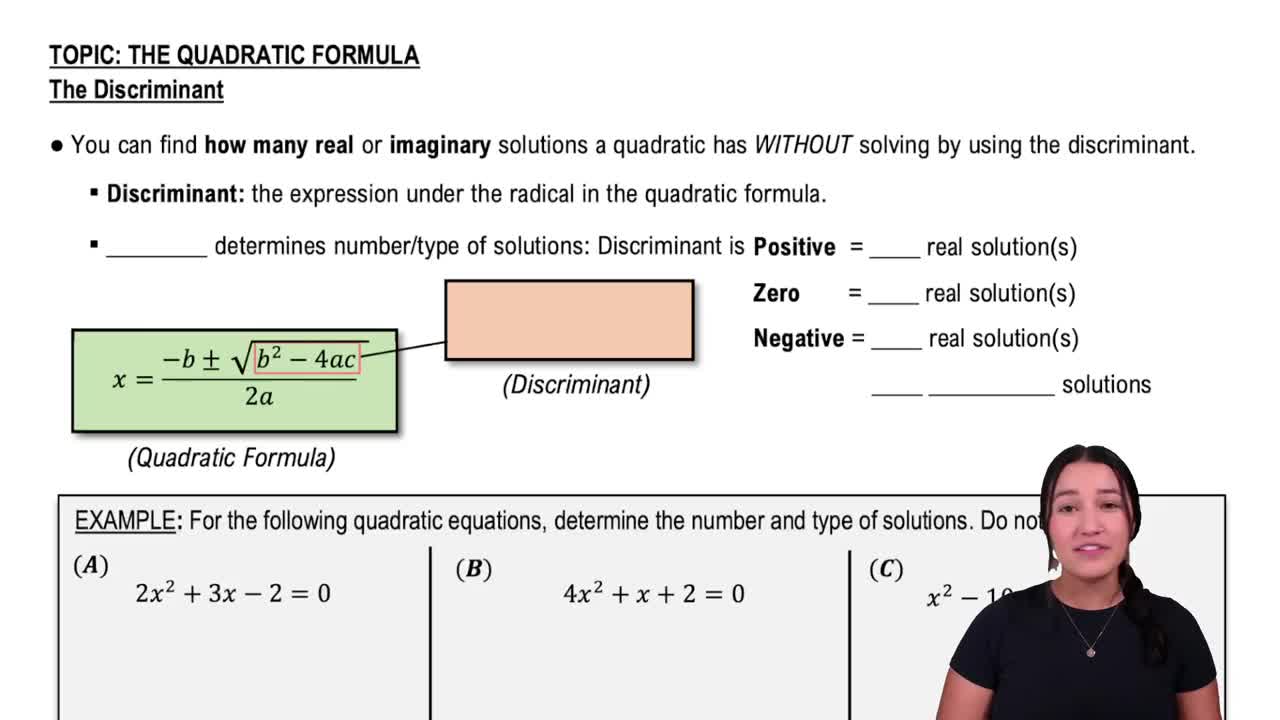
What is the discriminant in the quadratic formula?
The discriminant is the expression b² - 4ac found under the square root in the formula.
How does the discriminant determine the number of real solutions?
If the discriminant is positive, there are two real solutions; if zero, one real solution; if negative, two imaginary solutions.
What happens if the discriminant is zero?
There is only one real solution to the quadratic equation.
What happens if the discriminant is negative?
There are no real solutions, but two imaginary solutions.
What happens if the discriminant is positive?
There are two real solutions to the quadratic equation.
How do you identify the values of a, b, and c in a quadratic equation?
a is the coefficient of x², b is the coefficient of x, and c is the constant term.
What is the first step when using the quadratic formula to solve an equation?
Identify the values of a, b, and c from the equation.
What does the plus or minus (±) sign in the quadratic formula indicate?
It means you must calculate two values: one by adding and one by subtracting the square root term.
How can you check if your solutions from the quadratic formula are correct?
Plug the solutions back into the original equation to verify they satisfy it.
What is the standard form of a quadratic equation?
The standard form is ax² + bx + c = 0.
Why is the quadratic formula useful compared to completing the square?
It works for any quadratic equation, even when a ≠ 1 or b is odd, and avoids messy calculations.
What is the square root part of the quadratic formula called?
It is called the discriminant, represented by b² - 4ac.
How can you quickly determine the number and type of solutions without fully solving a quadratic equation?
Calculate the discriminant and check its sign to know if there are two real, one real, or two imaginary solutions.