Back

The Square Root Property quiz

Control buttons has been changed to "navigation" mode.
1/15
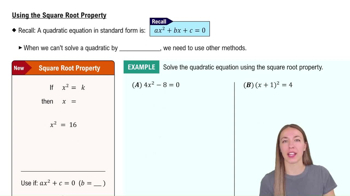
  • What is the square root property used for when solving quadratic equations?

    It is used when a squared quantity is isolated, allowing us to solve by taking the square root of both sides.
  • What is the general solution to x^2 = k using the square root property?

    x = ±√k, accounting for both positive and negative roots.
  • Why do we include both positive and negative roots when solving x^2 = k?

    Because both positive and negative values squared result in k.
  • What is the solution to x^2 = 16 using the square root property?

    x = ±4, since the square root of 16 is 4.
  • What is the first step in solving 4x^2 - 8 = 0 using the square root property?

    Add 8 to both sides to isolate the squared term.
  • After isolating 4x^2 = 8, what is the next step?

    Divide both sides by 4 to get x^2 = 2.
  • What are the solutions to x^2 = 2?

    x = ±√2, which cannot be simplified further.
  • How do you solve (x + 1)^2 = 4 using the square root property?

    Take the square root of both sides to get x + 1 = ±2.
  • What are the final solutions to (x + 1)^2 = 4?

    x = 1 and x = -3, after subtracting 1 from both ±2.
  • When can you use the square root property to solve a quadratic equation?

    When a squared term is isolated and equal to a constant.
  • Why can't all quadratic equations be solved by factoring?

    Because not all quadratics are factorable.
  • What should you do after finding solutions using the square root property?

    Check your answers by plugging them back into the original equation.
  • What type of quadratic equations commonly allow the use of the square root property?

    Equations missing the linear term (b coefficient is zero) or perfect square trinomials.
  • What happens when you take the square root of both sides of x^2 = k?

    The square and square root cancel, leaving x = ±√k.
  • How do you solve for x in (x + 1)^2 = 4 after applying the square root property?

    Subtract 1 from both sides to get x = -1 ± 2, which simplifies to x = 1 and x = -3.