Back

Translating Phrases to Expressions definitions

Control buttons has been changed to "navigation" mode.
1/15
  • Variable

    A letter, often x or y, used to represent an unknown value in an algebraic expression.
  • Addition

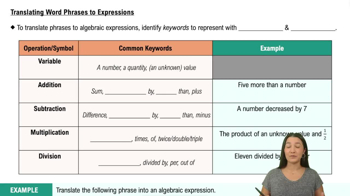
    An operation indicated by keywords like sum, more than, or plus, represented by the plus sign.
  • Subtraction

    An operation signaled by words such as difference, less than, or minus, shown with the minus sign.
  • Multiplication

    An operation denoted by product, times, or of, often shown with a dot or parentheses in algebra.
  • Division

    An operation indicated by quotient, divided by, or per, commonly represented as a fraction or with a slash.
  • Sum

    A result of adding two or more quantities, often signaled by keywords like more than or plus.
  • Difference

    A result of subtracting one quantity from another, often indicated by less than or decreased by.
  • Product

    A result of multiplying two or more values, often introduced by words like times or of.
  • Quotient

    A result of dividing one value by another, typically represented as a fraction in algebra.
  • Expression

    A combination of numbers, variables, and operations that represents a mathematical phrase.
  • Standard Form

    A way of writing expressions where terms are ordered and simplified according to algebraic conventions.
  • Unknown Value

    A quantity in a phrase that is not specified, typically represented by a variable.
  • Parentheses

    Symbols used to group parts of an expression, often indicating multiplication or clarifying order.
  • Fraction

    A way to represent division, with one number written above another, separated by a line.
  • Operation

    A mathematical process such as addition, subtraction, multiplication, or division used in expressions.