Back
Exponents and Polynomials: Structured Study Notes for Beginning Algebra
Study Guide - Smart Notes
 Tailored notes based on your materials, expanded with key definitions, examples, and context.
Exponents
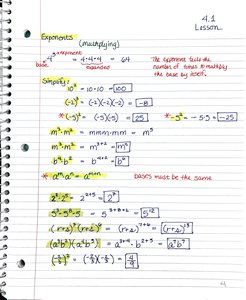
Multiplying Exponents
Exponents are a fundamental concept in algebra, representing repeated multiplication of a base number. When multiplying expressions with exponents, the rules depend on whether the bases are the same.
Definition: An exponent indicates how many times to multiply the base by itself.
Product Rule: When multiplying like bases, add the exponents:
Example:
Application:
Dividing with Exponents
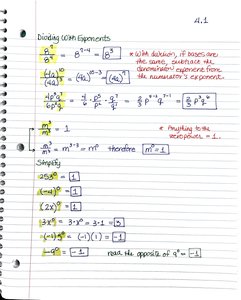
When dividing expressions with exponents and the same base, subtract the exponent in the denominator from the exponent in the numerator.
Quotient Rule:
Example:
Zero Exponent: Any nonzero number raised to the zero power equals 1:
Raising a Power to a Power
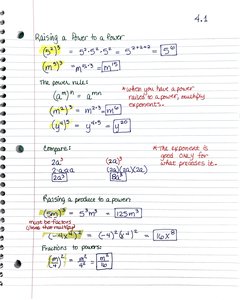
When an exponent is raised to another exponent, multiply the exponents together.
Power Rule:
Example:
Product to a Power:
Fraction to a Power:
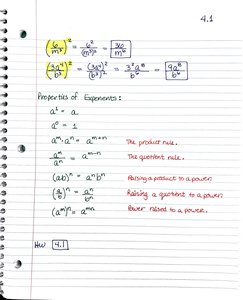
Properties of Exponents
Several key properties govern the manipulation of exponents in algebraic expressions.
Product Rule:
Quotient Rule:
Power Rule:
Product to a Power:
Quotient to a Power:
Negative Exponents
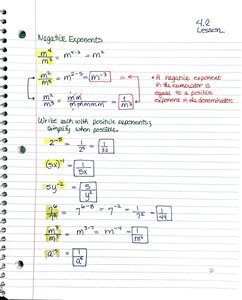
Definition and Simplification
Negative exponents indicate reciprocals. A negative exponent in the numerator becomes a positive exponent in the denominator, and vice versa.
Rule:
Example:
Application:
Expressing and Simplifying Negative Exponents
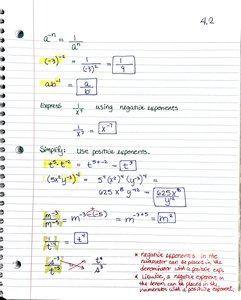
Negative exponents can be rewritten as positive exponents by moving the base to the opposite part of the fraction.
Example:
Example:
Application:
Scientific Notation
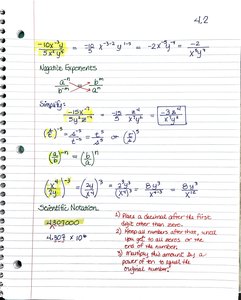
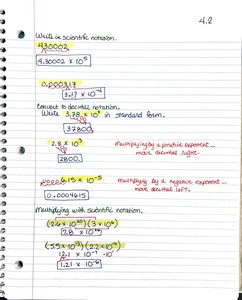
Scientific notation is a method for expressing very large or very small numbers using powers of ten.
Rule: Move the decimal point so that only one nonzero digit remains to the left. Count the number of places moved as the exponent of 10.
Example:
Example:
Operations with Scientific Notation
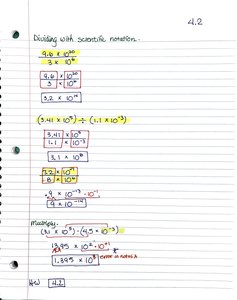
Multiplying and dividing numbers in scientific notation involves combining the coefficients and applying exponent rules.
Multiplication:
Division:
Example:
Example:
Polynomials
Definition and Classification
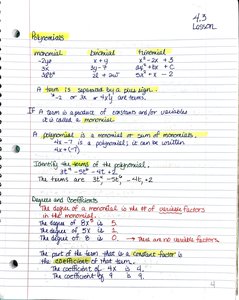
Polynomials are algebraic expressions consisting of terms separated by plus or minus signs. Each term is a product of a constant and variables raised to whole number exponents.
Monomial: One term (e.g., )
Binomial: Two terms (e.g., )
Trinomial: Three terms (e.g., )
Polynomial: A sum of monomials
Degrees and Coefficients
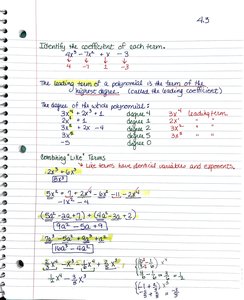
The degree of a polynomial is the highest exponent of its variable. The coefficient is the numerical factor of each term.
Degree: The exponent of the variable in a term
Coefficient: The number multiplying the variable
Example: In , degree is 3, coefficient is 5
Combining Like Terms
Like terms in polynomials have identical variables and exponents. They can be combined by adding or subtracting their coefficients.
Rule: Only like terms can be combined
Example:
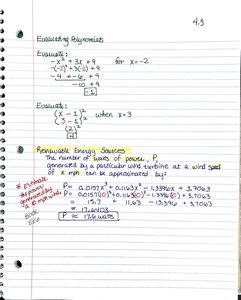
Evaluating Polynomials
To evaluate a polynomial, substitute the given value for the variable and perform the arithmetic operations.
Example: Evaluate for
Application: Substitute and calculate:
Real-World Applications: Renewable Energy Sources
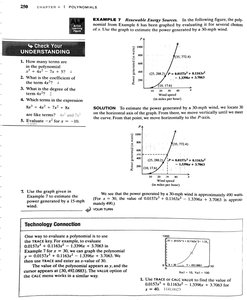
Polynomials can model real-world phenomena, such as the power generated by a wind turbine. The number of watts produced can be approximated by a polynomial function of wind speed.
Example:
Application: Substitute wind speed for to estimate power output
Adding and Subtracting Polynomials
Adding Polynomials
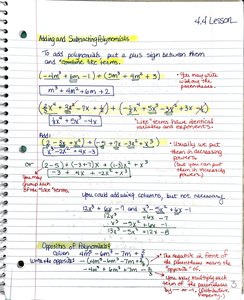
To add polynomials, combine like terms by adding their coefficients.
Rule: Arrange terms so like terms are together
Example:
Subtracting Polynomials
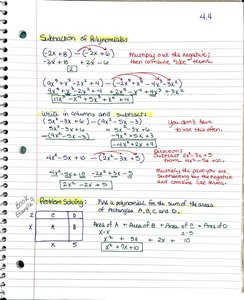
To subtract polynomials, distribute the negative sign and combine like terms.
Rule: Multiply out the negative, then combine like terms
Example:
Problem Solving with Polynomials
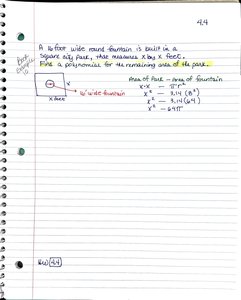
Polynomials can be used to solve area problems and other applications by expressing the sum or difference of areas as polynomial expressions.
Example: Find the area of a park minus the area of a fountain:
Application: Area of rectangle minus area of circle
Multiplying Polynomials
Multiplication Rules
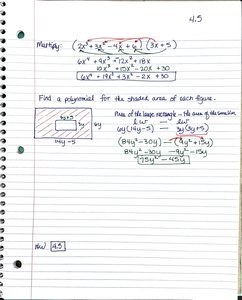
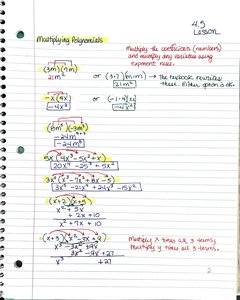
To multiply polynomials, multiply the coefficients and apply exponent rules to the variables.
Rule: Use distributive property and combine like terms
Example:
Application:
Area Problems with Polynomials
Multiplying polynomials can be used to find the area of shaded regions by subtracting the area of one figure from another.
Example: Area of rectangle minus area of smaller rectangle: