Back
Multiplying, Evaluating, and Dividing Polynomials: Beginning Algebra Study Notes
Study Guide - Smart Notes
 Tailored notes based on your materials, expanded with key definitions, examples, and context.
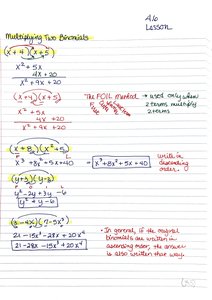
Multiplying Two Binomials
FOIL Method and Binomial Multiplication
Multiplying two binomials is a fundamental skill in algebra, often accomplished using the FOIL method. The FOIL method stands for First, Outside, Inside, Last, referring to the order in which terms are multiplied.
FOIL Method: Multiply the first terms, then the outside terms, then the inside terms, and finally the last terms.
Example:
General Rule: The product of two binomials is .
Combining Like Terms: After multiplying, combine terms with the same variable and exponent.
Multiplying Sums and Differences of Two Terms
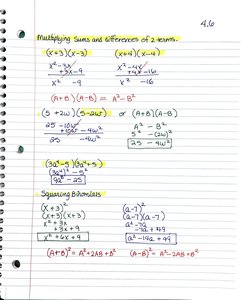
Special Products: Difference of Squares
Multiplying sums and differences of two terms often results in special products, such as the difference of squares.
Difference of Squares:
Example:
Application: Useful for simplifying expressions and solving equations.
Squaring Binomials
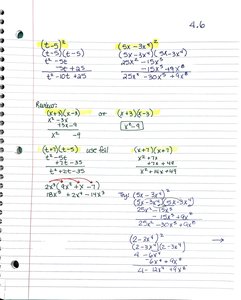
Squaring a binomial produces a trinomial according to the formula:
Formula:
Example:
Multiplying Polynomials
Expanding Products of Binomials and Polynomials
Multiplying polynomials involves distributing each term in one polynomial to every term in the other.
Distributive Property:
Example:
Combining Like Terms: After expansion, combine terms with identical variables and exponents.
Applications: Area and Polynomial Expressions
Finding Area Using Polynomials
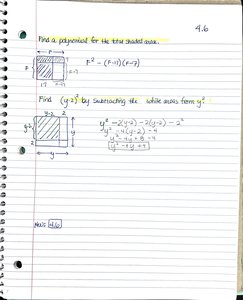
Polynomials can represent geometric areas, especially when dimensions are expressed algebraically.
Example: The area of a rectangle with sides and is .
Subtracting Areas: To find the area of a shaded region, subtract the area of the smaller shape from the larger.
Evaluating Polynomials
Substituting Values
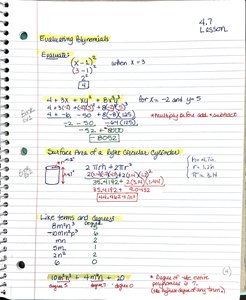
Evaluating a polynomial means substituting specific values for the variables and performing arithmetic operations.
Example: For , evaluate :
Multiple Variables: Substitute each variable with its given value and follow the order of operations.
Surface Area of a Right Circular Cylinder
The surface area of a cylinder can be expressed as a polynomial:
Formula:
Application: Substitute values for and to find the surface area.
Like Terms and Degrees
Combining Like Terms
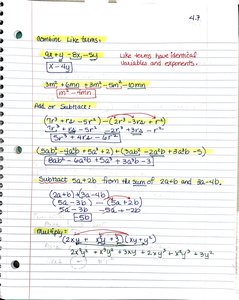
Like terms have identical variables and exponents. Combining like terms simplifies expressions.
Example: and
Adding/Subtracting: Add or subtract coefficients of like terms.
Degree of a Polynomial
The degree is the highest exponent of the variable in the polynomial.
Example: has degree 3.
Multiplying Binomials and Area Formulas
Using FOIL and Area Formulas
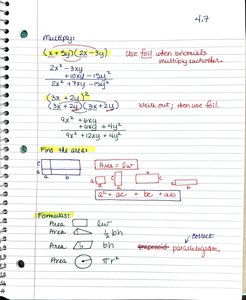
When multiplying binomials, use the FOIL method. Area formulas are often expressed as polynomials.
Rectangle:
Triangle:
Circle:
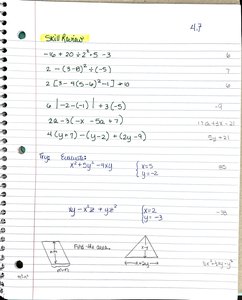
Skill Review: Evaluating and Area
Practice Problems
Skill review includes evaluating expressions and finding areas of geometric shapes using polynomials.
Example: Evaluate for , .
Area of Triangle:
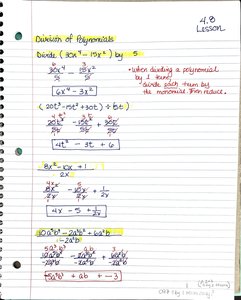
Division of Polynomials
Dividing by a Monomial
When dividing a polynomial by a monomial, divide each term separately and reduce.
Example: divided by $2
Reduce: Simplify each term after division.
Dividing by Binomials
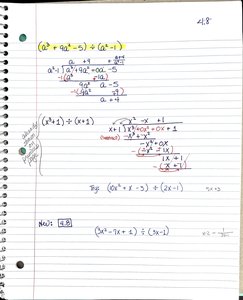
Dividing by binomials involves polynomial long division or synthetic division.
Example:
Steps: 1) Divide, 2) Multiply back, 3) Subtract, 4) Bring down next term.
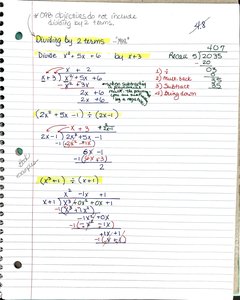
Division with Higher Degree Polynomials
For division involving higher degree polynomials, follow the same steps as with binomials, ensuring all terms are accounted for.
Example:
Result: