Back
BackRatios, Proportions, and Similarity in Beginning Algebra
Study Guide - Smart Notes
 Tailored notes based on your materials, expanded with key definitions, examples, and context.
Ratios and Extended Ratios
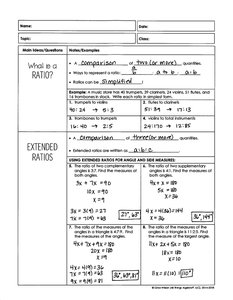
What is a Ratio?
A ratio is a comparison of two or more quantities, often expressed in simplest form. Ratios are used to represent relationships between numbers, such as parts to whole or part to part.
Key Point 1: Ratios can be written as fractions, with a colon, or as a to b (e.g., 2:3, , or 2 to 3).
Key Point 2: Ratios should be simplified whenever possible.
Example: If there are 24 apples and 18 oranges, the ratio of apples to oranges is or 4:3.
Extended Ratios
Extended ratios compare three or more quantities. They are useful in problems involving multiple parts, such as angles in a triangle or sides of a polygon.
Key Point 1: Extended ratios are written as a:b:c and can be used to set up equations for unknown values.
Key Point 2: To solve problems, assign variables and use the sum of the parts to find individual values.
Example: If the ratio of angles in a triangle is 2:3:4, and the sum of the angles is 180°, set up to solve for x.
Proportions
What is a Proportion?
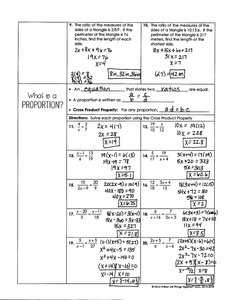
A proportion is an equation stating that two ratios are equal. Proportions are fundamental in solving problems involving similar figures, scaling, and indirect measurement.
Key Point 1: Proportions are written as .
Key Point 2: The cross product property states that for any proportion.
Example: To solve , use cross multiplication: .
Similar Polygons and Scale Factor
Similar Polygons
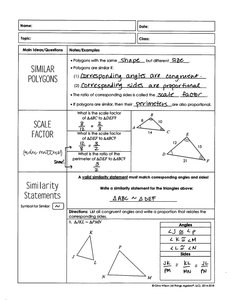
Polygons are similar if they have the same shape but not necessarily the same size. Corresponding angles are congruent, and corresponding sides are proportional.
Key Point 1: The ratio of corresponding side lengths is called the scale factor.
Key Point 2: Similarity statements must match corresponding angles and sides.
Example: If triangle ABC ~ triangle DEF, then , , , and .
Scale Factor
The scale factor is the ratio of the lengths of corresponding sides in similar figures. It is used to find unknown side lengths and to compare sizes of similar shapes.
Key Point 1: To find the scale factor, divide the length of a side in one figure by the corresponding side in the other figure.
Key Point 2: Use the scale factor to solve for missing sides by setting up proportions.
Example: If has sides 6, 8, 10 and has sides 3, 4, 5, the scale factor is .
Finding Side Lengths in Similar Figures
Using Proportions to Find Side Lengths
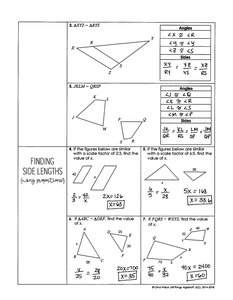
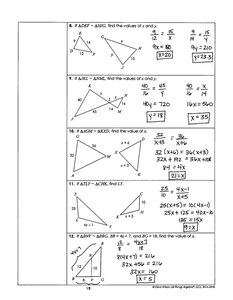
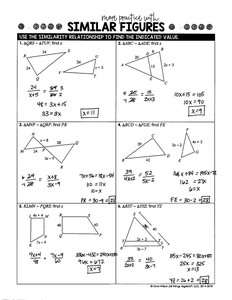
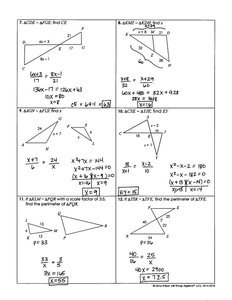
When two figures are similar, corresponding side lengths are proportional. This allows us to set up equations to solve for unknown values.
Key Point 1: Set up a proportion using the scale factor and solve for the unknown side.
Key Point 2: Always match corresponding sides correctly based on the similarity statement.
Example: If and , , , , then , so .
Triangle Similarity Criteria
AA, SSS, and SAS Similarity
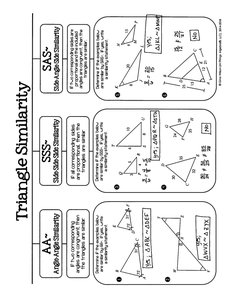
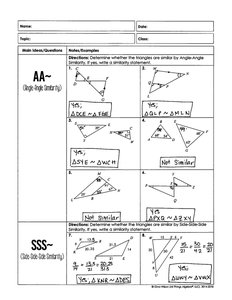
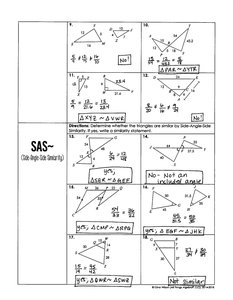
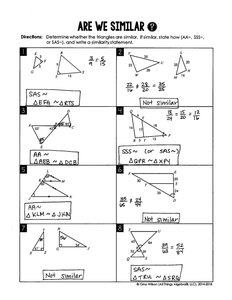
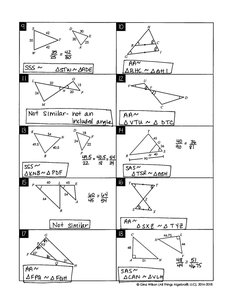
Triangles are similar if they satisfy one of three criteria: Angle-Angle (AA), Side-Side-Side (SSS), or Side-Angle-Side (SAS).
Key Point 1: AA Similarity: If two angles of one triangle are congruent to two angles of another triangle, the triangles are similar.
Key Point 2: SSS Similarity: If the ratios of all three pairs of corresponding sides are equal, the triangles are similar.
Key Point 3: SAS Similarity: If the ratios of two pairs of corresponding sides are equal and the included angles are congruent, the triangles are similar.
Example: If and have , , then AA similarity applies.
Triangle Proportionality Theorem
Triangle Proportionality Theorem
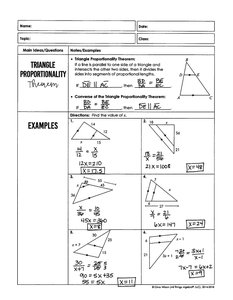
The Triangle Proportionality Theorem states that if a line parallel to one side of a triangle intersects the other two sides, it divides those sides proportionally.
Key Point 1: The theorem allows us to set up proportions to solve for unknown side lengths.
Key Point 2: The converse is also true: if a line divides two sides proportionally, it is parallel to the third side.
Example: If has , then .
Parallel Lines and Proportional Parts
Parallel Lines and Proportional Parts
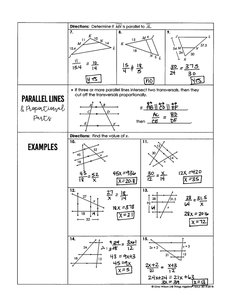
If three or more parallel lines intersect two transversals, they cut off the transversals proportionally. This property is useful in solving for unknown segments in geometric figures.
Key Point 1: Set up proportions using the segments created by the parallel lines.
Key Point 2: Use algebraic methods to solve for unknown values.
Example: If parallel lines cut a transversal into segments of 3, 4, and 5, and another transversal into segments of x, y, and z, then .
Parts of Similar Triangles
Parts of Similar Triangles
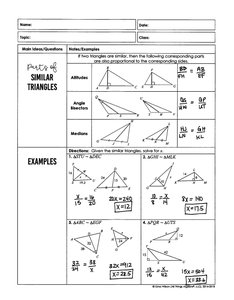
If two triangles are similar, then corresponding parts such as altitudes, angle bisectors, and medians are proportional to the corresponding sides.
Key Point 1: Proportionality applies to all corresponding segments, not just sides.
Key Point 2: Use proportions to solve for unknown values in similar triangles.
Example: If , then .
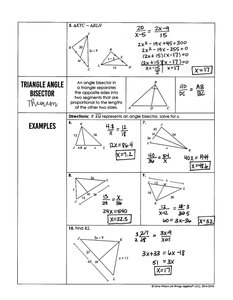
Triangle Angle Bisector Theorem
Triangle Angle Bisector Theorem
An angle bisector in a triangle separates the opposite side into segments that are proportional to the other two sides of the triangle.
Key Point 1: The theorem states , where AD is the angle bisector.
Key Point 2: Use this property to solve for unknown segment lengths.
Example: In , if AD bisects , then .