 Back
BackStep-by-Step Guidance for Beginning Algebra Word Problems
Study Guide - Smart Notes
 Tailored notes based on your materials, expanded with key definitions, examples, and context.
Q1. Five more than six times a quantity is three hundred five. Find the number.
Background
Topic: Translating and Solving Linear Equations from Word Problems
This question tests your ability to translate a verbal statement into an algebraic equation and solve for the unknown variable.
Key Terms and Formulas
Let represent the unknown quantity.
"Six times a quantity" means .
"Five more than six times a quantity" means .
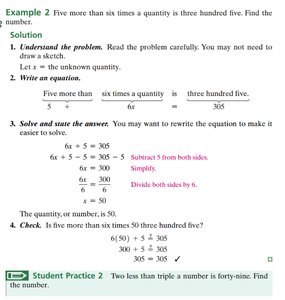
Set up the equation: .
Step-by-Step Guidance
Let be the unknown number you are trying to find.
Translate the words into an equation: .
Subtract $5x$.
Simplify the equation to get .
Divide both sides by $6x$.
Try solving on your own before revealing the answer!
Final Answer:
After dividing, you find that the unknown number is $50 back into the original equation: .
Q2. The larger of two numbers is three more than twice the smaller. The sum of the numbers is thirty-nine. Find each number.
Background
Topic: Systems of Equations/Translating Word Problems
This question tests your ability to set up and solve equations involving two unknowns, based on relationships described in words.
Key Terms and Formulas
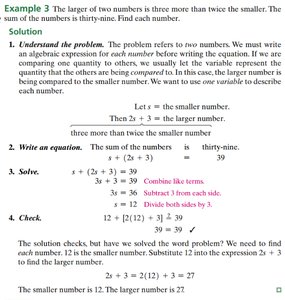
Let = the smaller number.
The larger number is .
The sum of the numbers is .
Step-by-Step Guidance
Let be the smaller number, and be the larger number.
Write the equation for their sum: .
Combine like terms to get .
Subtract $3x$.
Solve for by dividing both sides by $3$.
Try solving on your own before revealing the answer!
Final Answer: The smaller number is $12.
Substitute into to get $27.
Q3. Consider two numbers. The second number is twelve less than triple the first number. The sum of the two numbers is twenty-four. Find each number.
Background
Topic: Translating and Solving Linear Equations with Two Variables
This question tests your ability to translate a relationship between two numbers into an equation and solve for both numbers.
Key Terms and Formulas
Let = the first number.
The second number is .
The sum is .

Step-by-Step Guidance
Let be the first number, and be the second number.
Write the equation for their sum: .
Combine like terms to get .
Add $12x$.
Divide both sides by $4x$.
Try solving on your own before revealing the answer!
Final Answer: The first number is $9.
Substitute into to get $15.
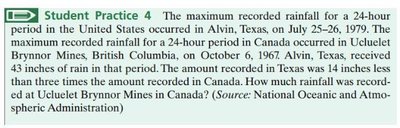
Q4. The mean annual snowfall in Juneau, Alaska, is 105.8 inches. This is 20.2 inches less than three times the annual snowfall in Boston. What is the annual snowfall in Boston?
Background
Topic: Translating Word Problems into Equations (Application: Averages and Differences)
This question tests your ability to set up and solve equations involving averages and differences, using real-world data.
Key Terms and Formulas
Let = annual snowfall in Boston (in inches).
Juneau's snowfall is inches.
"20.2 inches less than three times Boston's snowfall" means .
Set up the equation: .
Step-by-Step Guidance
Let be the annual snowfall in Boston.
Write the equation: .
Add to both sides to isolate the term with .
Simplify the equation to get .
Divide both sides by $3b$.
Try solving on your own before revealing the answer!
Final Answer: The annual snowfall in Boston is $42$ inches.
Substitute into to check: .
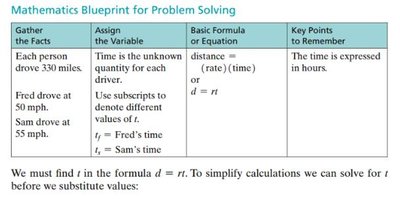
Q5. Two people traveled in separate cars. They each traveled a distance of 330 miles on an interstate highway. Fred traveled at exactly 50 mph. Sam traveled at exactly 55 mph. How much time did the trip take each person?
Background
Topic: Distance, Rate, and Time Problems
This question tests your ability to use the formula for distance, rate, and time to solve for the time taken by each person.
Key Terms and Formulas
Distance formula:
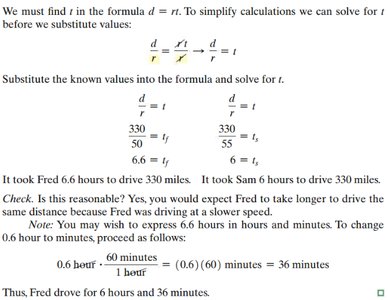
To solve for time:
Fred's rate: $50 mph, Distance: $330$ miles
Step-by-Step Guidance
Write the formula for time: .
For Fred: .
For Sam: .
Calculate each value to find the time taken by Fred and Sam.
Try solving on your own before revealing the answer!
Final Answer: Fred drove for hours, Sam drove for $6$ hours.
Fred's time: hours. Sam's time: hours.
Q6. A teacher told Melinda that she had a course average of 78 based on her six math tests. When she got home, Melinda found five of her test scores: 87, 63, 79, 71, and 96. What score did she obtain on the sixth test?
Background
Topic: Solving for an Unknown Using the Average Formula
This question tests your ability to use the formula for the average to solve for a missing value when the average and other values are known.
Key Terms and Formulas
Average formula:
Let be the unknown sixth test score.
Set up the equation:
Step-by-Step Guidance
Add the five known test scores: .
Let be the sixth test score. Write the equation: .
Multiply both sides by $6$ to clear the denominator.
Simplify to get .
Subtract the sum of the five scores from $468x$.
Try solving on your own before revealing the answer!
Final Answer: Melinda's sixth test score was $72$.
After subtracting the sum of the five scores from $468x = 72$.
