 Back
BackStep-by-Step Guidance for Math 0001 Exam #1A (Beginning Algebra)
Study Guide - Smart Notes
 Tailored notes based on your materials, expanded with key definitions, examples, and context.
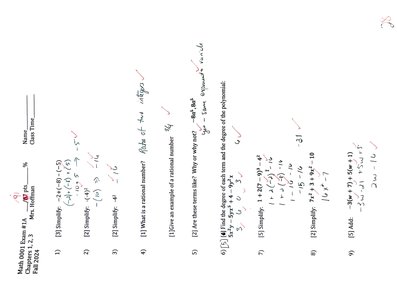
Q1. Simplify: -2 + (-8) - (-5)
Background
Topic: Integer Operations
This question tests your understanding of how to add and subtract integers, including the use of parentheses and negative signs.
Key Terms and Formulas:
Integer: Whole numbers and their opposites (e.g., -2, -8, 5).
Subtraction of a negative:
Step-by-Step Guidance
Rewrite the expression, noting that subtracting a negative is the same as adding: becomes .
Add the first two numbers: .
Take the result from step 2 and add 5.
Try solving on your own before revealing the answer!
Final Answer: -5
, then .
Subtracting a negative is equivalent to adding, so the final result is -5.
Q2. Simplify: -(-4)^2
Background
Topic: Order of Operations and Exponents
This question tests your understanding of how to apply exponents and negative signs, especially when parentheses are involved.
Key Terms and Formulas:
Exponent: means multiplying by itself times.
Order of Operations: PEMDAS (Parentheses, Exponents, Multiplication/Division, Addition/Subtraction).
Step-by-Step Guidance
Identify the base and exponent: means .
Calculate .
Apply the negative sign outside the parentheses: .
Try solving on your own before revealing the answer!
Final Answer: -16
, so is the result.
The negative sign outside the parentheses changes the positive result to negative.
Q3. Simplify: -42
Background
Topic: Integer Identification
This question checks your ability to recognize and interpret negative numbers.
Key Terms:
Negative integer: Any whole number less than zero.
Step-by-Step Guidance
Recognize that is already simplified; it is a negative integer.
No further calculation is needed.
Try solving on your own before revealing the answer!
Final Answer: -42
is already in its simplest form.
Q4. What is a rational number?
Background
Topic: Number Types
This question tests your understanding of the definition of rational numbers.
Key Terms:
Rational number: Any number that can be written as a fraction , where and are integers and .
Step-by-Step Guidance
Recall the definition: Rational numbers can be expressed as fractions.
Think of examples such as , , or .
Try solving on your own before revealing the answer!
Final Answer: A rational number is any number that can be written as a fraction , where and are integers and .
Examples include , , and .
Q5. Give an example of a rational number
Background
Topic: Number Types
This question checks your ability to identify and provide an example of a rational number.
Key Terms:
Rational number: Can be written as .
Step-by-Step Guidance
Recall the definition from the previous question.
Choose any number that fits the definition, such as , , or .
Try solving on your own before revealing the answer!
Final Answer: Example:
is a rational number because it can be written as a fraction.
Q6. Are these terms like? Why or why not? -8a^5, 8a^5
Background
Topic: Like Terms
This question tests your understanding of what makes terms "like" in algebraic expressions.
Key Terms:
Like terms: Terms that have the same variable(s) raised to the same power(s).
Step-by-Step Guidance
Compare the variable parts of each term: and both have .
Check if the coefficients (numbers in front) affect whether they are like terms (they do not).
Conclude whether the terms are like based on their variable parts.
Try solving on your own before revealing the answer!
Final Answer: Yes, they are like terms because both have .
The coefficients are different, but the variable part is identical.
Q7. Find the degree of each term and the degree of the polynomial: 5x^2y - 5yx^3 + 49y^2x
Background
Topic: Degree of Terms and Polynomials
This question tests your ability to find the degree of individual terms and the overall degree of a polynomial.
Key Terms and Formulas:
Degree of a term: The sum of the exponents of all variables in the term.
Degree of a polynomial: The highest degree among all its terms.
Step-by-Step Guidance
For each term, add the exponents of the variables:
: has exponent 2, has exponent 1. Degree = .
: has exponent 1, has exponent 3. Degree = .
: has exponent 2, has exponent 1. Degree = .
Identify the highest degree among the terms for the polynomial's degree.
Try solving on your own before revealing the answer!
Final Answer: Degrees are 3, 4, and 3. The degree of the polynomial is 4.
The highest degree among the terms is 4, so the polynomial's degree is 4.
Q8. Simplify: 1 + 2(7 - 9)^3 - 42
Background
Topic: Order of Operations (PEMDAS)
This question tests your ability to follow the correct order of operations when simplifying expressions.
Key Terms and Formulas:
Order of Operations: Parentheses, Exponents, Multiplication/Division, Addition/Subtraction.
Step-by-Step Guidance
Start with the parentheses: .
Raise the result to the third power: .
Multiply by 2: .
Add 1 and subtract 42: .
Try solving on your own before revealing the answer!
Final Answer: -55
Following the order of operations, the simplified result is -55.
Q9. Add: -3(w + 7) + 5(w + 1)
Background
Topic: Combining Like Terms and Distributive Property
This question tests your ability to use the distributive property and combine like terms in algebraic expressions.
Key Terms and Formulas:
Distributive Property:
Like terms: Terms with the same variable(s) and exponent(s).
Step-by-Step Guidance
Apply the distributive property to each part: and .
Expand each expression: and .
Add the expanded expressions together: .
Combine like terms: group terms and constant terms.
Try solving on your own before revealing the answer!
Final Answer: 2w - 16
After combining like terms, the result is .
