 Back
BackTranslating Vertices on the Coordinate Plane
Study Guide - Smart Notes
 Tailored notes based on your materials, expanded with key definitions, examples, and context.
Q1. Write the coordinates of the vertices after a translation 4 units right and 5 units up.
Background
Topic: Translations on the Coordinate Plane
This question tests your understanding of how to apply translations to points on the coordinate plane. A translation moves every point of a shape the same distance in the same direction.
Key Terms and Formulas
Translation: A transformation that slides each point of a figure the same distance in a given direction.
Coordinate Rule for Translation: To translate a point $(x, y)$ by $a$ units right and $b$ units up, use the rule:
$$(x, y) \rightarrow (x + a, y + b)$$
For this problem: $a = 4$ (right), $b = 5$ (up)
Step-by-Step Guidance
Identify the original coordinates of each vertex (Q, R, S, T) from the graph.
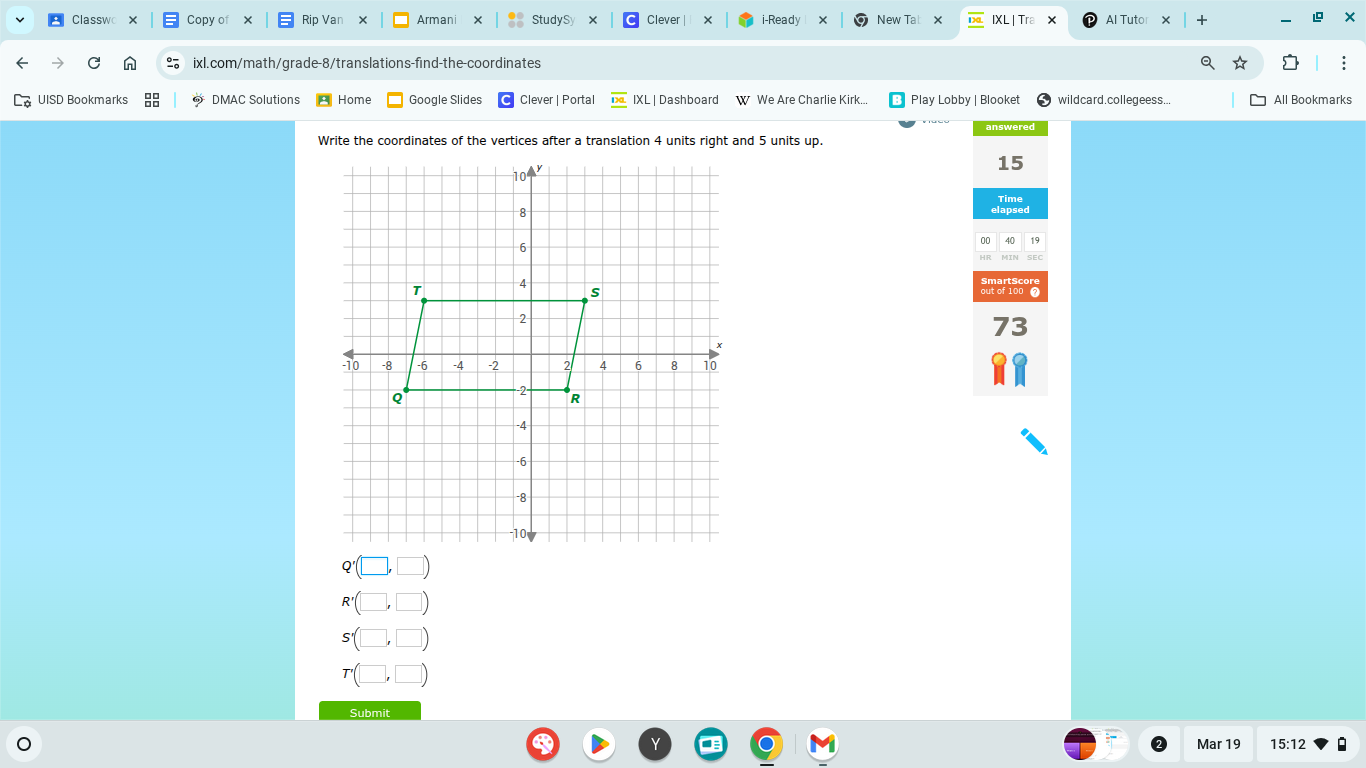
Write down the translation rule for this problem: $(x, y) \rightarrow (x + 4, y + 5)$.
Apply the translation rule to each vertex:
For Q: If Q is at $(x_1, y_1)$, the new position is $(x_1 + 4, y_1 + 5)$.
For R: If R is at $(x_2, y_2)$, the new position is $(x_2 + 4, y_2 + 5)$.
For S: If S is at $(x_3, y_3)$, the new position is $(x_3 + 4, y_3 + 5)$.
For T: If T is at $(x_4, y_4)$, the new position is $(x_4 + 4, y_4 + 5)$.
Substitute the original coordinates for each vertex into the translation rule, but do not calculate the final values yet.
Try solving on your own before revealing the answer!
Final Answer:
Q' = (-5, 3)
R' = (2, 3)
S' = (3, 7)
T' = (-4, 7)
Each vertex was shifted 4 units to the right and 5 units up according to the translation rule.
