 Back
BackUnderstanding Fractions Using Shaded Shapes
Study Guide - Smart Notes
 Tailored notes based on your materials, expanded with key definitions, examples, and context.
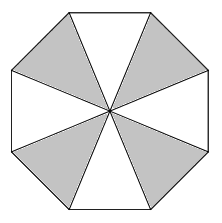
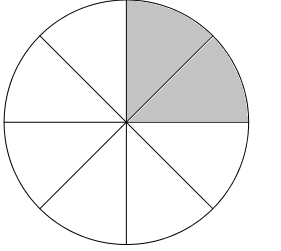
Q1. What fraction of each shape is shaded?
Background
Topic: Fractions and Visual Representation
This question is testing your ability to interpret fractions by looking at shaded portions of geometric shapes. It helps you understand how fractions represent parts of a whole.
Key Terms:
Fraction: A way to represent a part of a whole, written as where is the number of shaded parts and is the total number of equal parts.
Numerator: The top number in a fraction, representing the shaded (or selected) parts.
Denominator: The bottom number in a fraction, representing the total number of equal parts.
Step-by-Step Guidance
Count the total number of equal sections in each shape. This will be your denominator ().
Count the number of shaded sections in each shape. This will be your numerator ().
Write the fraction for each shape as , where is the number of shaded parts and is the total number of parts.
Check if the fraction can be simplified by finding the greatest common divisor (GCD) of and .
Try solving on your own before revealing the answer!
Final Answer:
For the first shape (octagon), there are 8 sections and 4 are shaded, so the fraction is , which simplifies to .
For the second shape (circle), there are 8 sections and 2 are shaded, so the fraction is , which simplifies to .
We counted the shaded and total sections, then wrote and simplified the fractions.
