Skip to main content
Biochemistry
My Course
Learn
Exam Prep
AI Tutor
Study Guides
Flashcards
Explore
Try the app
My Course
Learn
Exam Prep
AI Tutor
Study Guides
Flashcards
Explore
Try the app
Back
Acids and Bases definitions
You can tap to flip the card.
Bronsted Lowry Acid
You can tap to flip the card.
👆
Bronsted Lowry Acid
Substance capable of donating a proton, resulting in a decrease of hydrogen and charge after reaction.
Track progress
Control buttons has been changed to "navigation" mode.
1/15
Related flashcards
Related practice
Recommended videos
Acids and Bases quiz #1
Acids and Bases
10 Terms
Acids and Bases
2. Water
7 problems
Topic
Autoionization of Water
2. Water
7 problems
Topic
2. Water - Part 1 of 3
4 topics
11 problems
Chapter
2. Water - Part 2 of 3
5 topics
11 problems
Chapter
2. Water - Part 3 of 3
4 topics
11 problems
Chapter
Guided course
04:31
Br∅nsted-Lowry Acids & Bases
2174
views
32
rank
Terms in this set (15)
Hide definitions
Bronsted Lowry Acid
Substance capable of donating a proton, resulting in a decrease of hydrogen and charge after reaction.
Bronsted Lowry Base
Substance capable of accepting a proton, leading to an increase in hydrogen and charge after reaction.
Conjugate Acid
Species formed after a base accepts a proton, possessing one more hydrogen and an extra positive charge.
Conjugate Base
Species formed after an acid donates a proton, having one less hydrogen and an extra negative charge.
Parent Acid
Original molecule in a reaction that donates a proton, often containing an acidic hydrogen.
Parent Base
Original molecule in a reaction that accepts a proton, typically possessing lone pairs for bonding.
Carboxylic Acid
Compound containing a carboxyl group, acts as a proton donor in acid-base reactions.
Water
Molecule capable of acting as both acid and base, demonstrating amphiprotic behavior in reactions.
Amphiprotic Molecule
Species able to function as either a proton donor or acceptor, depending on reaction context.
Hydroxide Ion
Negatively charged species formed when water donates a proton, serving as a conjugate base.
Ammonium Ion
Positively charged species formed when ammonia accepts a proton, serving as a conjugate acid.
Carboxyl Group
Functional group present in carboxylic acids, responsible for acidic properties and proton donation.
Acidic Hydrogen
Hydrogen atom in a molecule that is readily donated during acid-base reactions.
Charge
Electrical property altered during proton transfer, increasing or decreasing based on gain or loss of hydrogen.
Lone Pair
Non-bonding electrons on atoms, often involved in accepting protons during base reactions.
 BackBack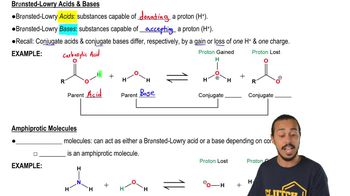
 04:31
04:31