Back

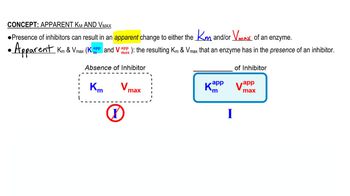
Apparent Km and Vmax definitions

Control buttons has been changed to "navigation" mode.
1/13
  • Apparent Km

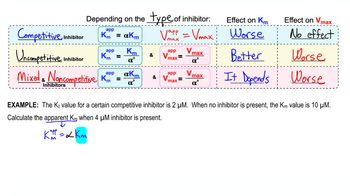
    Reflects substrate affinity of an enzyme in the presence of an inhibitor, differing from its normal value based on inhibitor type.
  • Apparent Vmax

    Represents the maximum reaction velocity of an enzyme when an inhibitor is present, altered according to inhibition factors.
  • Competitive Inhibitor

    Molecule that increases substrate affinity constant without affecting maximum velocity, by binding to the free enzyme.
  • Uncompetitive Inhibitor

    Compound that decreases both substrate affinity constant and maximum velocity by binding to the enzyme-substrate complex.
  • Mixed Inhibitor

    Agent that variably alters substrate affinity constant and maximum velocity, depending on inhibition factors for enzyme and complex.
  • Noncompetitive Inhibitor

    Specific mixed inhibitor that decreases maximum velocity, with effects on substrate affinity constant depending on inhibition factors.
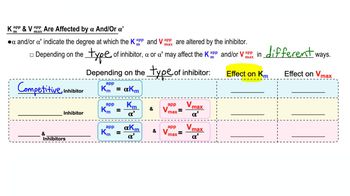
  • Alpha

    Degree of inhibition factor quantifying how much an inhibitor affects the free enzyme, always greater than or equal to one.
  • Alpha Prime

    Degree of inhibition factor measuring inhibitor impact on the enzyme-substrate complex, always greater than or equal to one.
  • Enzyme-Substrate Complex

    Intermediate formed when an enzyme binds its substrate, target for certain inhibitors affecting kinetic parameters.
  • Substrate Affinity

    Strength of binding between enzyme and substrate, inferred from changes in the substrate affinity constant.
  • Maximum Velocity

    Highest possible rate of an enzyme-catalyzed reaction, altered in the presence of specific inhibitors.
  • Reversible Inhibitor

    Compound that temporarily binds to an enzyme, modifying kinetic parameters without permanent enzyme alteration.
  • Catalytic Efficiency

    Measure of enzyme performance, influenced by changes in substrate affinity constant and maximum velocity due to inhibitors.