Back

Biosignaling 1 definitions

Control buttons has been changed to "navigation" mode.
1/15
  • Signal Transduction

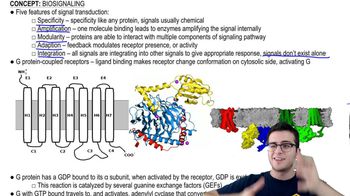
    Cellular process where external signals are relayed and converted into specific responses through a series of molecular interactions.
  • Specificity

    Feature ensuring precise recognition between signaling molecules and their protein targets, similar to enzyme-substrate interactions.
  • Amplification

    Mechanism where a single signal triggers the activation of many downstream molecules, greatly increasing the cellular response.
  • Modularity

    Characteristic allowing proteins to interact with multiple pathway components, enhancing signaling versatility and efficiency.
  • Adaption

    Feedback-driven adjustment of receptor activity, enabling cells to fine-tune their response to ongoing signals.
  • Integration

    Process combining multiple signaling inputs to generate a coordinated cellular outcome, reflecting complex pathway interactions.
  • G Protein-Coupled Receptor

    Membrane protein with seven transmembrane domains that transmits signals via G proteins upon ligand binding.
  • Ligand

    Molecule, often a hormone, that binds to a receptor to initiate a signaling cascade within the cell.
  • G Protein

    Trimeric protein complex that transmits signals from activated receptors to downstream effectors, cycling between active and inactive states.
  • Alpha Subunit

    Component of the G protein responsible for binding and hydrolyzing GTP, mediating activation and inactivation.
  • Adenylyl Cyclase

    Enzyme activated by G proteins that catalyzes the conversion of ATP to cyclic AMP, a key secondary messenger.
  • Cyclic AMP

    Cyclized nucleotide acting as a secondary messenger, relaying signals and regulating various cellular processes.
  • GDP

    Nucleotide bound to inactive G proteins, replaced by GTP upon receptor activation to initiate signaling.
  • GTP

    Nucleotide that activates G proteins, enabling them to interact with downstream effectors before being hydrolyzed.
  • GTPase-Activating Protein

    Regulatory protein that accelerates GTP hydrolysis by G proteins, helping to attenuate and modulate signaling.