Back

Biosignaling 1 quiz

Control buttons has been changed to "navigation" mode.
1/15
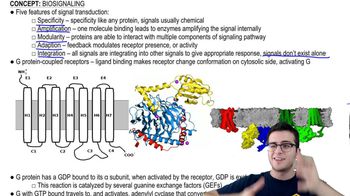
  • What are the five key features of signal transduction in biosignaling?

    The five key features are specificity, amplification, modularity, adaption, and integration.
  • How does specificity function in biosignaling pathways?

    Specificity refers to the precise interaction between proteins and their chemical signals, ensuring accurate cellular responses.
  • What is meant by amplification in the context of signal transduction?

    Amplification means that one molecule binding to a receptor can activate many enzymes, leading to the production of thousands of downstream molecules.
  • How does modularity contribute to signal transduction?

    Modularity allows proteins to interact with multiple components within a signaling pathway, increasing versatility and efficiency.
  • What role does adaption play in biosignaling?

    Adaption involves feedback mechanisms that modulate receptor activity, allowing the pathway to adjust its response based on downstream signals.
  • Why is integration important in cellular signaling?

    Integration combines multiple signals to produce a coherent cellular response, ensuring that the cell coordinates its activities appropriately.
  • What is a defining structural feature of G protein-coupled receptors (GPCRs)?

    GPCRs are characterized by having seven transmembrane domains.
  • What happens when a ligand binds to a GPCR?

    Ligand binding causes GDP on the G protein to be replaced by GTP, activating the G protein.
  • Which enzyme does the activated G protein interact with, and what is the result?

    The activated G protein interacts with adenylyl cyclase, which then converts ATP to cyclic AMP (cAMP).
  • What is the function of cyclic AMP (cAMP) in signal transduction?

    cAMP acts as a secondary messenger, relaying and amplifying the signal within the cell.
  • What intrinsic activity does the G protein possess?

    The G protein functions as a GTPase, slowly hydrolyzing GTP to GDP to inactivate itself.
  • How do GTPase-activating proteins (GAPs) affect G protein signaling?

    GAPs accelerate the hydrolysis of GTP to GDP by the G protein, helping to modulate and attenuate the signal.
  • Which subunit of the G protein is responsible for binding GTP and GDP?

    The alpha subunit of the G protein binds GTP and GDP.
  • What is the role of guanine exchange factors in GPCR signaling?

    Guanine exchange factors catalyze the exchange of GDP for GTP on the G protein, activating it.
  • Why is it important that multiple signaling pathways are integrated in the cell?

    Because cells receive many signals simultaneously, integration ensures that the cell produces the appropriate and coordinated response.