Back

Biosignaling 3 quiz

Control buttons has been changed to "navigation" mode.
1/15
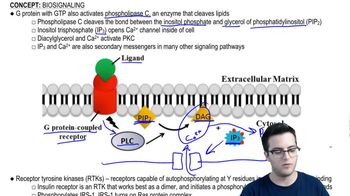
  • What enzyme does a G protein activate to cleave PIP2 in cell signaling?

    A G protein activates phospholipase C, which cleaves PIP2 into DAG and IP3.
  • What are the two products formed when phospholipase C cleaves PIP2?

    The two products are diacylglycerol (DAG) and inositol triphosphate (IP3).
  • Where does DAG remain after PIP2 is cleaved?

    DAG remains in the cell membrane because it is hydrophobic.
  • What happens to IP3 after it is produced from PIP2?

    IP3 diffuses into the cell and triggers the release of calcium from internal stores.
  • Which two molecules activate protein kinase C in the signaling pathway?

    Diacylglycerol (DAG) and calcium activate protein kinase C.
  • What type of receptor is the insulin receptor classified as?

    The insulin receptor is a receptor tyrosine kinase (RTK).
  • What process do RTKs undergo upon ligand binding?

    RTKs undergo autophosphorylation, adding phosphate groups to their own tyrosine residues.
  • What protein does the phosphorylated insulin receptor activate first in its signaling cascade?

    It activates IRS1 (insulin receptor substrate 1).
  • What is the role of IRS1 in the insulin signaling pathway?

    IRS1 activates the RAS protein complex, which leads to a phosphorylation cascade.
  • What is the final effect of ERK activation in the insulin signaling pathway?

    ERK enters the nucleus and activates gene expression.
  • How does insulin signaling increase glucose uptake by cells?

    It increases the number of GLUT4 glucose transporters in the cell membrane.
  • What enzyme does protein kinase B inactivate to promote glycogen synthesis?

    Protein kinase B inactivates GSK3 (glycogen synthase kinase 3).
  • How does inactivation of GSK3 affect glycogen synthase?

    Inactivation of GSK3 allows glycogen synthase to become active and synthesize glycogen.
  • Why does insulin promote glycogen formation in cells?

    Insulin promotes glycogen formation to store excess glucose for later use.
  • What is the overall effect of insulin on blood sugar levels?

    Insulin lowers blood sugar levels by increasing glucose uptake and promoting emblycogen synthesis.