Back

cAMP & PKA definitions

Control buttons has been changed to "navigation" mode.
1/15
  • GPCR

    Membrane protein that detects extracellular signals like hormones and initiates intracellular signaling cascades.
  • Adenylyl Cyclase

    Effector enzyme activated by G protein that converts ATP into the secondary messenger cAMP.
  • ATP

    Cellular energy molecule serving as the substrate for adenylyl cyclase in cAMP production.
  • cAMP

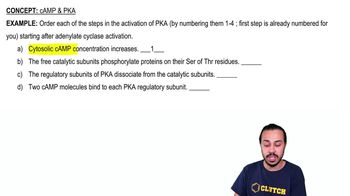
    Cyclic nucleotide acting as a secondary messenger and allosteric activator for PKA in signaling pathways.
  • Protein Kinase A

    Enzyme regulated by cAMP, phosphorylates serine/threonine residues on target proteins to modulate cellular responses.
  • Regulatory Subunit

    Component of PKA that binds cAMP, enabling release and activation of catalytic subunits.
  • Catalytic Subunit

    Active part of PKA released upon cAMP binding, responsible for phosphorylating target proteins.
  • Serine/Threonine Kinase

    Enzyme class that transfers phosphate groups to serine or threonine residues on proteins.
  • Phosphorylation

    Addition of a phosphate group to proteins, altering their activity and triggering cellular responses.
  • AMP

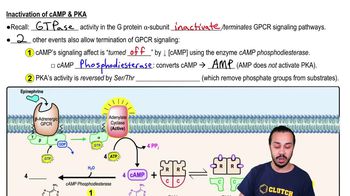
    Non-cyclic nucleotide produced from cAMP by phosphodiesterase, unable to activate PKA.
  • Phosphodiesterase

    Enzyme that converts cAMP to AMP, decreasing cAMP concentration and terminating signaling.
  • Serine/Threonine Phosphatase

    Enzyme that removes phosphate groups from proteins, reversing PKA-mediated phosphorylation.
  • Heterotetramer

    Inactive PKA structure composed of two regulatory and two catalytic subunits.
  • Secondary Messenger

    Intracellular signaling molecule, such as cAMP, that amplifies and transmits signals from receptors.
  • Ligand

    Molecule like epinephrine that binds to GPCR, triggering conformational changes and signal transduction.