Pearson+ LogoPearson+ Logo

Central Dogma quiz #1 Flashcards

Back
Central Dogma quiz #1
Control buttons has been changed to "navigation" mode.
1/40
  • What is the central dogma of molecular biology, and what does it state about the flow of genetic information?

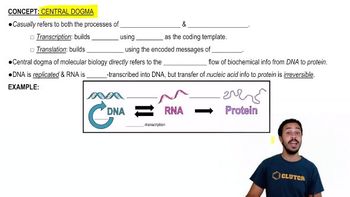
    The central dogma of molecular biology describes the unidirectional flow of genetic information from DNA to RNA to protein, stating that once information is transferred to protein, it cannot revert back to nucleic acids.
  • What enzyme is responsible for transcription, and in which direction does it synthesize RNA?

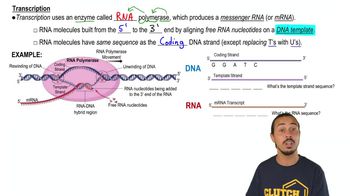
    RNA polymerase is responsible for transcription, and it synthesizes RNA in the 5' to 3' direction.
  • How does the sequence of the RNA transcript compare to the DNA coding and template strands during transcription?

    The RNA transcript has the same sequence as the DNA coding strand, except that uracil (U) replaces thymine (T); it is complementary to the DNA template strand.
  • What are codons and anticodons, and how do they function during translation?

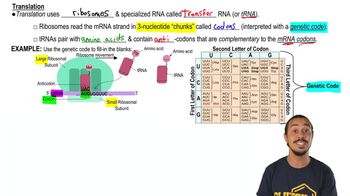
    Codons are three-nucleotide sequences on mRNA that specify amino acids; anticodons are complementary sequences on tRNA that pair with codons to bring the correct amino acids during translation.
  • Where do transcription and translation occur in eukaryotic cells, and what are the main macromolecule changes in each process?

    In eukaryotic cells, transcription occurs in the nucleus and produces RNA from DNA (no macromolecule category change), while translation occurs in the cytoplasm and produces proteins from RNA (macromolecule category changes from nucleic acid to protein).
  • What is the significance of the universality of the genetic code in translation?

    The genetic code is nearly universal across all living organisms, meaning that the same codons specify the same amino acids in almost all species, allowing for consistency in protein synthesis.
  • What does the central dogma of molecular biology state about the direction of genetic information flow?

    The central dogma states that genetic information flows unidirectionally from DNA to RNA to protein, and once information is in protein form, it cannot revert back to nucleic acids.
  • Which enzyme is responsible for synthesizing RNA during transcription, and in which direction does it build the RNA strand?

    RNA polymerase is responsible for transcription and it synthesizes RNA in the 5' to 3' direction.
  • How does the sequence of the RNA transcript compare to the DNA coding and template strands during transcription?

    The RNA transcript has the same sequence as the DNA coding strand except that uracil (U) replaces thymine (T), and it is complementary to the DNA template strand.
  • What are codons and anticodons, and how do they interact during translation?

    Codons are three-nucleotide sequences on mRNA that specify amino acids, while anticodons are complementary sequences on tRNA that pair with codons to ensure the correct amino acid is added during translation.
  • Where does protein synthesis occur in eukaryotic cells?

    Protein synthesis occurs in the cytoplasm of eukaryotic cells.
  • How many nucleotides make up one codon?

    One codon is made up of three nucleotides.
  • How many codons code for one amino acid?

    One codon codes for one amino acid, although some amino acids are specified by multiple codons.
  • Where does the second step of protein synthesis, translation, occur in eukaryotic cells?

    Translation occurs in the cytoplasm of eukaryotic cells.
  • What are the main steps in protein synthesis?

    The main steps in protein synthesis are transcription and translation.
  • How many codons are required to specify one amino acid?

    One codon specifies one amino acid.
  • How many codons equal one amino acid?

    One codon equals one amino acid.
  • How many codons code for an amino acid?

    One codon codes for an amino acid, but some amino acids are coded by more than one codon.
  • Name an amino acid that is specified by more than one codon.

    Leucine is an example of an amino acid that is specified by more than one codon.
  • Which amino acid is coded by the codon CUA?

    The codon CUA codes for the amino acid leucine.
  • Which enzyme is responsible for synthesizing RNA during transcription?

    RNA polymerase is the enzyme responsible for synthesizing RNA during transcription.
  • Which amino acid does the codon AUG code for?

    The codon AUG codes for the amino acid methionine.
  • What are the sites of protein synthesis in the cell?

    Ribosomes are the sites of protein synthesis in the cell.
  • What is the process of protein formation directed by mRNA called?

    The process of protein formation directed by mRNA is called translation.
  • Which nucleic acid is translated to make a protein?

    Messenger RNA (mRNA) is translated to make a protein.
  • What is the enzyme that catalyzes transcription?

    RNA polymerase catalyzes transcription.
  • AUG codes for which amino acid?

    AUG codes for methionine.
  • Which enzyme catalyzes the process of transcription?

    RNA polymerase catalyzes the process of transcription.
  • Which enzyme is involved in catalyzing transcription?

    RNA polymerase is involved in catalyzing transcription.
  • What enzyme is responsible for transcription?

    RNA polymerase is responsible for transcription.
  • What enzyme synthesizes mRNA during transcription?

    RNA polymerase synthesizes mRNA during transcription.
  • What is the function of tRNA in protein synthesis?

    tRNA brings the appropriate amino acids to the ribosome by matching its anticodon to the mRNA codon during translation.
  • What enzyme catalyzes transcription?

    RNA polymerase catalyzes transcription.
  • What enzyme builds mRNA from a DNA template?

    RNA polymerase builds mRNA from a DNA template.
  • What is the enzyme that synthesizes mRNA?

    RNA polymerase synthesizes mRNA.
  • Which enzyme unwinds the DNA parent strand during transcription?

    RNA polymerase unwinds the DNA parent strand during transcription.
  • What enzyme is responsible for making mRNA?

    RNA polymerase is responsible for making mRNA.
  • The codon CCU codes for which amino acid?

    The codon CCU codes for the amino acid proline.
  • What are the two main steps of protein synthesis?

    The two main steps of protein synthesis are transcription and translation.
  • What is the first step of protein synthesis?

    The first step of protein synthesis is transcription.