What type of functional group is found in the R group of a basic amino acid?
A basic amino acid has an R group that contains an ionizable nitrogen atom, typically in the form of an amino group, which can accept a hydrogen ion (H+).
What characteristic does the side chain of a basic amino acid have at physiological pH?
At physiological pH, the side chain of a basic amino acid contains an ionizable nitrogen atom that can accept a hydrogen ion, resulting in a positively charged side chain.
Which amino acid is responsible for forming disulfide bonds in proteins?
Cysteine is the amino acid that forms disulfide bonds in proteins through the oxidation of its thiol (–SH) groups.
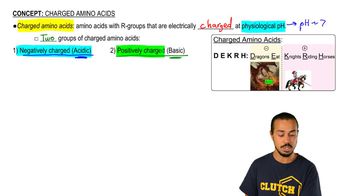
What mnemonic is used to remember the five charged amino acids and their subgroups?
The mnemonic is 'Dragons Eat Knights Riding Horses.' It helps categorize aspartic acid and glutamic acid as acidic, and lysine, arginine, and histidine as basic.
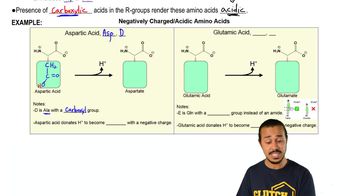
How does the structure of aspartic acid differ from alanine?
Aspartic acid is alanine with an added carboxyl group in its R group. This carboxyl group is responsible for its acidic properties.
What structural feature distinguishes glutamic acid from aspartic acid?
Glutamic acid has an extra CH2 group in its R group compared to aspartic acid. This makes its side chain longer.
At physiological pH, what reaction occurs to aspartic acid's R group?
Aspartic acid donates a hydrogen ion from its carboxyl group, forming aspartate with a negatively charged carboxylate. This reaction defines its acidic behavior.
What is the key structural feature of lysine's R group that relates to its mnemonic?
Lysine's R group has a four-carbon chain ending in an amino group, resembling a knight's sword. The four carbons correspond to the four pointy ends of the letter 'K.'
How does arginine's R group combine features of lysine and histidine?
Arginine's R group starts with a three-carbon chain and ends with a triangular nitrogen structure. This structure mixes the sword-like chain of lysine and the ring features of histidine.
Why are basic amino acids not classified as acids despite having extra hydrogens?
Basic amino acids are classified by their ability to accept hydrogen ions at physiological pH, not donate them. Their behavior under these conditions defines them as bases.
 Back
Back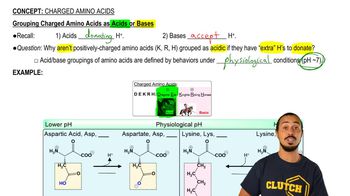
 05:52
05:52