Back

Functional Groups definitions

Control buttons has been changed to "navigation" mode.
1/15
  • Functional Group

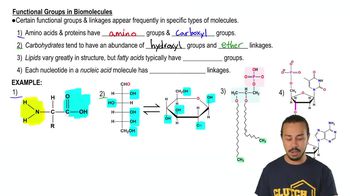
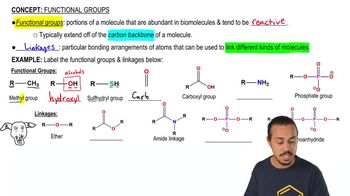
    Specific reactive portion of a biomolecule branching from a carbon backbone, often determining chemical properties.
  • Methyl Group

    A CH3 unit attached to a carbon chain, commonly found at the ends of fatty acid hydrocarbon chains.
  • Hydroxyl Group

    An oxygen atom bonded to a hydrogen atom, abundant in carbohydrates and responsible for alcohol properties.
  • Sulfhydryl Group

    A sulfur atom bonded to a hydrogen atom, often present in proteins and contributing to their structure.
  • Carbonyl Group

    A carbon atom double bonded to an oxygen atom, frequently incorporated into other functional groups.
  • Carboxyl Group

    A combination of a carbonyl and hydroxyl group, typically found at the end of amino acids and proteins.
  • Amino Group

    A nitrogen atom bonded to hydrogen atoms, characteristic of proteins and nucleic acid bases.
  • Phosphate Group

    A phosphorus atom surrounded by oxygen atoms, central to nucleic acids and energy molecules.
  • Ether Linkage

    An oxygen atom connecting two carbon chains, commonly seen in carbohydrates and lipids.
  • Ester Linkage

    A bond formed between a carbonyl and an oxygen atom, linking molecules within lipids and other biomolecules.
  • Amide Linkage

    A bond involving a carbonyl group and a nitrogen atom, essential in peptide bonds of proteins.
  • Phosphodiester Linkage

    A connection involving two phosphate ester bonds, crucial for linking nucleotides in nucleic acids.
  • Phosphoanhydride Linkage

    A bond joining two phosphate groups, important in energy storage molecules like ATP.
  • Macromolecule

    Large biomolecule such as proteins, carbohydrates, lipids, or nucleic acids, built from repeating units and functional groups.
  • CHNOPS

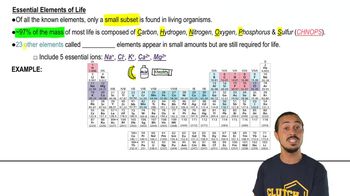
    A mnemonic for the six elements—carbon, hydrogen, nitrogen, oxygen, phosphorus, sulfur—comprising most of living matter.