Back

Chitin quiz

Control buttons has been changed to "navigation" mode.
1/15
  • What type of polysaccharide is chitin?

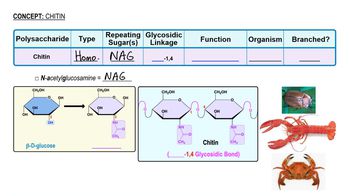
    Chitin is a homopolysaccharide, meaning it is composed of only one type of repeating sugar unit.
  • What is the repeating sugar unit in chitin called?

    The repeating sugar unit in chitin is N-acetylglucosamine (NAG).
  • How is N-acetylglucosamine (NAG) derived from β-D-glucose?

    NAG is derived by replacing the hydroxyl group at carbon 2 of β-D-glucose with an N-acetyl group.
  • What type of bond links NAG units in chitin?

    NAG units in chitin are linked by β-1,4-glycosidic bonds.
  • What structural function does the β-configuration of chitin’s glycosidic linkages provide?

    The β-configuration confers a structural function, making chitin rigid and strong.
  • Is chitin a branched or unbranched polysaccharide?

    Chitin is an unbranched polysaccharide.
  • What organisms commonly contain chitin?

    Chitin is found in the exoskeletons of insects and crustaceans.
  • What is the abbreviation for N-acetylglucosamine?

    The abbreviation for N-acetylglucosamine is NAG.
  • What element is present in NAG that makes it an amino sugar?

    NAG contains a nitrogen atom, making it an amino sugar.
  • What is the main biological role of chitin?

    Chitin provides structural support and rigidity in the exoskeletons of certain animals.
  • What is replaced in β-D-glucose to form NAG?

    The hydroxyl group at carbon 2 is replaced with an N-acetyl group to form NAG.
  • What type of animals use chitin for their exoskeletons?

    Insects and crustaceans use chitin for their hard exoskeletons.
  • What is the significance of chitin’s β-1,4-glycosidic linkages?

    These linkages provide structural integrity and rigidity to chitin.
  • Why is chitin considered a structural biopolymer?

    Chitin’s β-glycosidic linkages and unbranched structure make it strong and suitable for structural roles.
  • What feature distinguishes NAG from regular glucose?

    NAG has an N-acetyl group at carbon 2, unlike regular glucose.