Back

Citric Acid Cycle Practice 1 definitions

Control buttons has been changed to "navigation" mode.
1/15
  • Pyruvate Dehydrogenase Complex

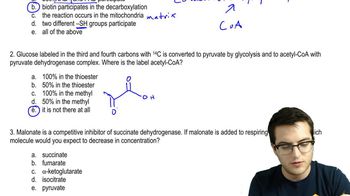
    Located in the mitochondrial matrix, this multi-enzyme system uses TPP, lipoate, and FAD as cofactors to convert pyruvate to acetyl CoA.
  • TPP

    A cofactor essential for decarboxylation reactions in the mitochondrial matrix, particularly in the conversion of pyruvate to acetyl CoA.
  • Lipoate

    A cofactor involved in acyl group transfer during the conversion of pyruvate to acetyl CoA within mitochondria.
  • FAD

    A cofactor participating in redox reactions, notably in the pyruvate dehydrogenase complex and succinate dehydrogenase.
  • NAD

    A molecule that accepts electrons during metabolic reactions, forming NADH in the pyruvate dehydrogenase complex.
  • Acetyl CoA

    A two-carbon molecule entering the citric acid cycle, formed from pyruvate but not considered a cycle intermediate.
  • Citrate

    A six-carbon compound formed by the condensation of acetyl CoA and oxaloacetate at the start of the citric acid cycle.
  • Isocitrate

    A citric acid cycle intermediate formed from citrate, involved in subsequent decarboxylation steps.
  • Oxaloacetate

    A four-carbon molecule that combines with acetyl CoA to initiate the citric acid cycle and can be labeled for isotope tracing.
  • Succinate

    A citric acid cycle intermediate whose concentration increases when succinate dehydrogenase is inhibited.
  • Fumarate

    A citric acid cycle intermediate whose concentration decreases when succinate dehydrogenase is competitively inhibited.
  • Malonate

    A competitive inhibitor of succinate dehydrogenase, causing changes in succinate and fumarate levels.
  • Decarboxylation

    A process in the citric acid cycle where carbon atoms are lost as CO2, affecting isotope labeling outcomes.
  • Mitochondrial Matrix

    The compartment within mitochondria where the pyruvate dehydrogenase complex and citric acid cycle reactions occur.
  • Isotope Tracing

    A technique using labeled molecules, such as carbon-14, to track metabolic flux and carbon loss in biochemical cycles.