Back

Citric Acid Cycle Practice 2 quiz

Control buttons has been changed to "navigation" mode.
1/15
  • How many NADH molecules are produced per turn of the citric acid cycle from one acetyl CoA?

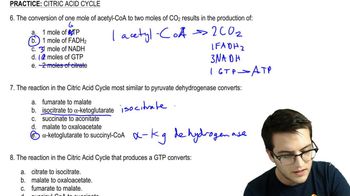
    Three NADH molecules are produced per turn of the citric acid cycle from one acetyl CoA.
  • Which enzyme in the citric acid cycle catalyzes the conversion of alpha-ketoglutarate to succinyl CoA?

    Alpha-ketoglutarate dehydrogenase catalyzes the conversion of alpha-ketoglutarate to succinyl CoA.
  • What are the main cofactors used by alpha-ketoglutarate dehydrogenase?

    Alpha-ketoglutarate dehydrogenase uses TPP, lipoate, FAD, NAD+, and CoA as cofactors.
  • Which citric acid cycle reaction produces GTP via substrate-level phosphorylation?

    The conversion of succinyl CoA to succinate produces GTP via substrate-level phosphorylation.
  • What is the fate of GTP produced in the citric acid cycle?

    GTP can be converted to ATP, but it is not necessarily always used for that purpose.
  • Which citric acid cycle intermediate is considered prochiral?

    Citrate is considered prochiral in the citric acid cycle.
  • What does it mean for a molecule to be prochiral?

    A prochiral molecule is not actually chiral but can behave as if it were chiral in certain enzyme-catalyzed reactions.
  • Which enzyme interacts with citrate as if it were chiral?

    Aconitase interacts with citrate as if it were chiral.
  • How many CO2 molecules are produced per turn of the citric acid cycle from one acetyl CoA?

    Two CO2 molecules are produced per turn of the citric acid cycle from one acetyl CoA.
  • How many FADH2 molecules are produced per turn of the citric acid cycle?

    One FADH2 molecule is produced per turn of the citric acid cycle.
  • How many ATP (or GTP) molecules are produced per turn of the citric acid cycle?

    One GTP (which can be converted to ATP) is produced per turn of the citric acid cycle.
  • What is the total number of NADH molecules produced from the conversion of one pyruvate to three CO2 via pyruvate dehydrogenase and the citric acid cycle?

    Four NADH molecules are produced: one from pyruvate oxidation and three from the citric acid cycle.
  • Which organisms can convert acetyl CoA into sugars via the glyoxylate cycle?

    Plants, fungi, and bacteria can convert acetyl CoA into sugars via the glyoxylate cycle.
  • Why can't humans convert acetyl CoA back into sugar?

    Humans lack the glyoxylate cycle, which is necessary for converting acetyl CoA into sugars.
  • What is the main metabolic significance of the glyoxylate cycle?

    The glyoxylate cycle enables the use of acetyl CoA for energy and the synthesis of biosynthetic precursors, including sugars.