Back

Taxonomy definitions

Control buttons has been changed to "navigation" mode.
1/15
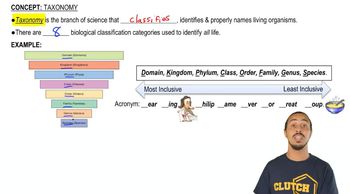
  • Taxonomy

    Branch of science organizing living organisms into hierarchical categories based on shared characteristics and evolutionary relationships.
  • Domain

    Most inclusive classification grouping all life; includes Bacteria, Archaea, and Eukarya, each with distinct cellular features.
  • Kingdom

    Second broadest classification level, grouping organisms within a domain based on fundamental traits.
  • Phylum

    Classification category below kingdom, grouping organisms by major structural similarities.
  • Class

    Taxonomic rank below phylum, organizing organisms with shared characteristics into distinct groups.
  • Order

    Taxonomic level below class, grouping families with similar features and evolutionary history.
  • Family

    Classification rank below order, grouping genera with closely related traits.
  • Genus

    Taxonomic category below family, grouping species with common ancestry and similar morphology.
  • Species

    Least inclusive classification, representing a single type of organism capable of interbreeding.
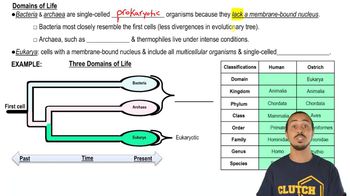
  • Bacteria

    Domain of prokaryotic, unicellular organisms with circular DNA, theorized to resemble earliest cells.
  • Archaea

    Domain of prokaryotes including extremophiles like halophiles and thermophiles, lacking membrane-bound nuclei.
  • Eukarya

    Domain of organisms with membrane-bound nuclei, including multicellular life and protists.
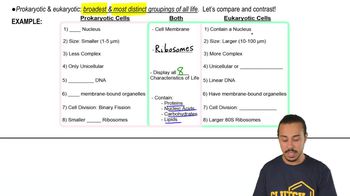
  • Prokaryotic Cell

    Cell type lacking membrane-bound nucleus and organelles, typically smaller and unicellular with circular DNA.
  • Eukaryotic Cell

    Cell type with membrane-bound nucleus and organelles, larger and more complex, containing linear DNA.
  • Ribosome

    Cellular structure present in all life, responsible for protein synthesis; size differs between cell types.