Back

Taxonomy quiz

Control buttons has been changed to "navigation" mode.
1/15
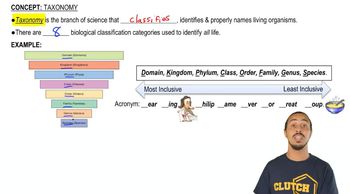
  • What is taxonomy?

    Taxonomy is the branch of science that classifies, identifies, and names all living organisms.
  • List the eight biological classification categories in order from most inclusive to least inclusive.

    The eight categories are domain, kingdom, phylum, class, order, family, genus, and species.
  • Which classification category is the most inclusive and which is the least inclusive?

    Domain is the most inclusive category, and species is the least inclusive.
  • What acronym can help you remember the order of the classification categories?

    The acronym is 'Dear King Philip Came Over For Great Soup.'
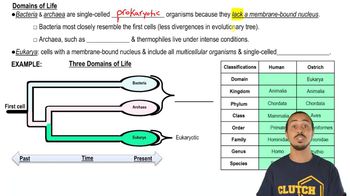
  • How many domains of life are there and what are their names?

    There are three domains: Bacteria, Archaea, and Eukarya.
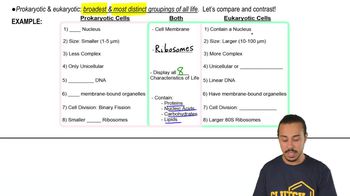
  • What is a key feature that distinguishes prokaryotic cells from eukaryotic cells?

    Prokaryotic cells lack a membrane-bound nucleus, while eukaryotic cells have a membrane-bound nucleus.
  • Which domains consist of prokaryotic organisms?

    Bacteria and Archaea are prokaryotic domains.
  • What types of environments do halophiles and thermophiles (types of Archaea) live in?

    Halophiles live in high salt conditions, and thermophiles live in high temperature conditions.
  • What is the main difference in DNA structure between prokaryotic and eukaryotic cells?

    Prokaryotic cells have circular DNA, while eukaryotic cells have linear DNA.
  • How do prokaryotic and eukaryotic cells differ in their method of cell division?

    Prokaryotic cells divide by binary fission, while eukaryotic cells divide by mitosis.
  • What is the size range of prokaryotic cells compared to eukaryotic cells?

    Prokaryotic cells are 1–5 micrometers in diameter, while eukaryotic cells are 10–100 micrometers.
  • What type of ribosomes do prokaryotic and eukaryotic cells have?

    Prokaryotic cells have 70S ribosomes, and eukaryotic cells have 80S ribosomes.
  • Name two cellular structures that both prokaryotic and eukaryotic cells share.

    Both have cell membranes and ribosomes.
  • What are the four major macromolecules found in all cells?

    Proteins, nucleic acids, carbohydrates, and lipids.
  • What does the biochemical unity of life suggest about prokaryotic and eukaryotic organisms?

    It suggests that all living organisms share similarities at the biochemical level, so knowledge about one can often apply to the other.