Back

Concerted (MWC) Model quiz

Control buttons has been changed to "navigation" mode.
1/15
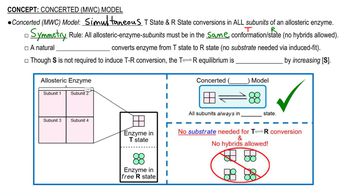
  • What does the term 'concerted' mean in the context of the concerted (MWC) model?

    It means that all subunits of an allosteric enzyme change conformation simultaneously, not individually.
  • What is the symmetry rule in the concerted model?

    The symmetry rule states that all subunits of an allosteric enzyme must be in the same conformation, either all T state or all R state.
  • Are hybrid states of T and R allowed in the concerted model?

    No, hybrid states are not allowed; all subunits must be either in the T state or the R state.
  • What are the two possible conformational states for allosteric enzyme subunits in the concerted model?

    The two possible states are the T (tense) state and the R (relaxed) state.
  • Can the conversion from T state to R state occur without substrate in the concerted model?

    Yes, the conversion can occur without substrate due to a natural equilibrium between the two states.
  • How does increasing substrate concentration affect the T to R state equilibrium?

    Increasing substrate concentration shifts the equilibrium toward the R state, promoting substrate binding.
  • What happens to the allosteric constant (Lā‚€) at low substrate concentrations?

    At low substrate concentrations, the T state is favored, so the allosteric constant Lā‚€ is large.
  • Is there any R state enzyme present at zero substrate concentration?

    Yes, a small percentage of the enzyme can exist in the R state even when no substrate is present.
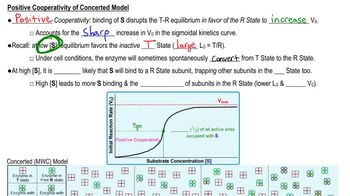
  • What is positive cooperativity in the context of the concerted model?

    Positive cooperativity means that binding of one substrate molecule to an R state subunit increases the likelihood of other subunits binding substrate.
  • How does substrate binding to one R state subunit affect the other subunits?

    It traps all other subunits in the R state, making them more likely to bind substrate.
  • What type of kinetics curve is explained by the concerted model for allosteric enzymes?

    The concerted model explains the sigmoidal kinetics curve observed in allosteric enzymes.
  • Why does the initial reaction velocity (Vā‚€) increase sharply as substrate concentration rises?

    Because more R state enzymes bind substrate, demonstrating positive cooperativity and leading to a sharp increase in Vā‚€.
  • What happens to the allosteric constant as the concentration of R state increases?

    As the concentration of R state increases, the allosteric constant decreases.
  • What does the concerted model suggest about the mechanism of allosteric enzyme activation?

    It suggests that all subunits switch states together, and substrate binding promotes the R state, enhancing enzyme activity.
  • At what point on the sigmoidal curve are all active sites occupied with substrate?

    When the initial reaction velocity approaches Vmax, all active sites are occupied with substrate.