Skip to main content
Biochemistry
My Course
Learn
Exam Prep
AI Tutor
Study Guides
Flashcards
Explore
Try the app
My Course
Learn
Exam Prep
AI Tutor
Study Guides
Flashcards
Explore
Try the app
Back
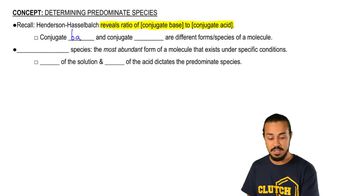
Determining Predominate Species definitions
You can tap to flip the card.
Predominant Species
You can tap to flip the card.
👆
Predominant Species
Most abundant molecular form present under specific pH and pKa conditions, indicating which version of a molecule is favored.
Track progress
Control buttons has been changed to "navigation" mode.
1/14
Related flashcards
Related practice
Recommended videos
Determining Predominate Species quiz #1
Determining Predominate Species
10 Terms
Determining Predominate Species
2. Water
7 problems
Topic
Titration
2. Water
7 problems
Topic
2. Water - Part 1 of 3
4 topics
11 problems
Chapter
2. Water - Part 2 of 3
5 topics
11 problems
Chapter
2. Water - Part 3 of 3
4 topics
11 problems
Chapter
Guided course
05:47
Determining Predominate Species
1555
views
10
rank
Guided course
01:08
Determining Predominate Species
1739
views
9
rank
2
comments
Terms in this set (14)
Hide definitions
Predominant Species
Most abundant molecular form present under specific pH and pKa conditions, indicating which version of a molecule is favored.
pH
Numerical measure of solution acidity or basicity, crucial for determining which molecular form is favored.
pKa
Value representing acid strength; comparison with pH reveals which molecular form predominates in solution.
Conjugate Acid
Protonated molecular form with one more hydrogen atom, favored when solution pH is below acid's pKa.
Conjugate Base
Deprotonated molecular form with one less hydrogen atom, favored when solution pH exceeds acid's pKa.
Henderson-Hasselbalch Equation
Mathematical relationship connecting pH, pKa, and the ratio of conjugate base to conjugate acid concentrations.
Protonated Molecule
Form of a molecule with an extra hydrogen atom, typically dominant when solution is more acidic.
Deprotonated Molecule
Form of a molecule missing a hydrogen atom, typically dominant when solution is more basic.
Concentration Ratio
Relative amounts of conjugate base and conjugate acid, used to determine which molecular form is most abundant.
Acidic Molecule
Substance capable of donating a proton, whose predominant form depends on pH and pKa comparison.
Species
Distinct molecular forms present in solution, determined by protonation state and environmental conditions.
Abundance
Extent to which a particular molecular form is present, indicating predominance under given conditions.
Logarithm
Mathematical function used in the Henderson-Hasselbalch equation to relate concentration ratios to pH.
Equilibrium
State where concentrations of conjugate acid and base are equal, occurring when pH matches pKa.
 BackBack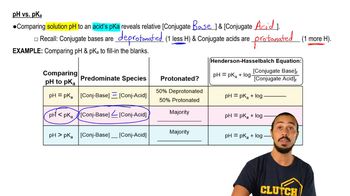
 05:47
05:47