Back

DNA Sequencing 2 quiz

Control buttons has been changed to "navigation" mode.
1/15
  • What is the role of dideoxynucleotide triphosphates in Sanger sequencing?

    Dideoxynucleotide triphosphates terminate DNA synthesis at specific bases, creating DNA fragments of varying lengths that can be analyzed to determine the DNA sequence.
  • How are DNA fragments separated in traditional Sanger sequencing?

    DNA fragments are separated by size using gel electrophoresis, with smaller fragments traveling further through the gel.
  • Why are only small amounts of dideoxynucleotides used in Sanger sequencing reactions?

    Small amounts ensure that only a subset of DNA strands are terminated at each base, allowing for the generation of fragments ending at every possible nucleotide position.
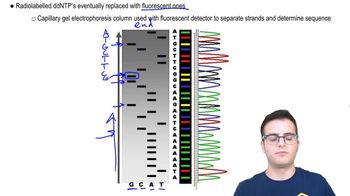
  • How does the use of fluorescent labels improve Sanger sequencing compared to radioactive labels?

    Fluorescent labels are safer, more efficient, and easier to detect than radioactive labels, eliminating the need for hazardous chemicals.
  • What is the function of a capillary gel column in modern Sanger sequencing?

    A capillary gel column separates DNA fragments by size, allowing for automated detection of fluorescent signals as fragments elute.
  • How is the DNA sequence determined from a gel electrophoresis result in Sanger sequencing?

    The sequence is read from the smallest to largest fragments, with each fragment's terminal base identified by the lane or color corresponding to the dideoxynucleotide used.
  • What is the main principle behind pyrosequencing?

    Pyrosequencing detects DNA synthesis by measuring light emitted from luciferase, which is activated by ATP produced when pyrophosphate is released during nucleotide incorporation.
  • Which enzymes are essential in the pyrosequencing reaction, and what are their roles?

    Sulfurylase converts pyrophosphate to ATP, and luciferase uses ATP to produce light, indicating nucleotide incorporation.
  • How does pyrosequencing determine which nucleotide was added to a DNA strand?

    By adding one nucleotide type at a time and detecting light emission, the method identifies which nucleotide was incorporated based on the presence of a light signal.
  • What is the key difference between pyrosequencing and Ion Torrent sequencing?

    Pyrosequencing detects light from luciferase activity, while Ion Torrent sequencing detects pH changes caused by proton release during nucleotide incorporation.
  • How does Ion Torrent sequencing detect DNA synthesis events?

    It measures changes in pH resulting from the release of protons when a nucleotide is incorporated into the DNA strand.
  • What is the biochemical event that both pyrosequencing and Ion Torrent sequencing rely on?

    Both rely on the release of pyrophosphate and protons during nucleotide incorporation by DNA polymerase.
  • Why is it important to add nucleotides one at a time in pyrosequencing?

    Adding nucleotides one at a time ensures that any detected light signal can be attributed to the specific nucleotide added, allowing accurate sequence determination.
  • What does a light peak indicate in a pyrosequencing experiment?

    A light peak indicates that the nucleotide just added was incorporated into the DNA strand, releasing pyrophosphate and generating ATP for luciferase.
  • Why is DNA polymerase activity essential in all the sequencing methods discussed?

    DNA polymerase incorporates nucleotides into the growing DNA strand, enabling the detection of sequence-specific events in all these sequencing technologies.