Back

Fatty Acid Oxidation 2 quiz

Control buttons has been changed to "navigation" mode.
1/15
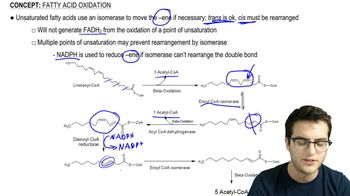
  • What enzyme is required to reposition cis double bonds during beta oxidation of unsaturated fatty acids?

    An isomerase is required to reposition cis double bonds to the 2-3 carbon position.
  • Why is FADH2 not produced during the isomerase step of unsaturated fatty acid beta oxidation?

    FADH2 is not produced because the double bond is moved rather than introduced, so the oxidation step that generates FADH2 does not occur.
  • What happens if an unsaturated fatty acid has multiple points of unsaturation that cannot be resolved by isomerase alone?

    NADPH is used to reduce the double bond, allowing further processing by beta oxidation.
  • What is the role of NADPH in the beta oxidation of certain unsaturated fatty acids?

    NADPH donates electrons to reduce double bonds that cannot be handled by isomerase alone.
  • What are the products of the final round of beta oxidation for an odd-chain fatty acid?

    The final round produces one acetyl-CoA (2 carbons) and one propionyl-CoA (3 carbons).
  • How is propionyl-CoA processed in the cell after beta oxidation of odd-chain fatty acids?

    Propionyl-CoA is carboxylated (using ATP) to form succinyl-CoA, which enters the citric acid cycle.
  • What is another name for the citric acid cycle?

    The citric acid cycle is also called the Krebs cycle or the tricarboxylic acid (TCA) cycle.
  • How many rounds of beta oxidation does palmitic acid (16 carbons) undergo?

    Palmitic acid undergoes 7 rounds of beta oxidation.
  • How many acetyl-CoA molecules are produced from the complete beta oxidation of palmitic acid?

    Eight acetyl-CoA molecules are produced from the complete beta oxidation of palmitic acid.
  • How many FADH2 and NADH molecules are generated directly from the beta oxidation of palmitic acid?

    Seven FADH2 and seven NADH molecules are generated directly from beta oxidation.
  • How much ATP is produced from the FADH2 and NADH generated during beta oxidation of palmitic acid?

    FADH2 yields 10.5 ATP and NADH yields 17.5 ATP from beta oxidation of palmitic acid.
  • How many FADH2, NADH, and ATP/GTP are produced from the citric acid cycle per acetyl-CoA?

    Each acetyl-CoA produces 1 FADH2, 3 NADH, and 1 ATP (or GTP) in the citric acid cycle.
  • What is the total ATP yield from complete oxidation of one palmitic acid molecule?

    Complete oxidation of one palmitic acid yields approximately 108 ATP.
  • Why does the body use glucose as an energy source despite the high ATP yield from fatty acids?

    Glucose provides more energy per unit weight than fatty acids, making it a more efficient energy source by weight.
  • What is the simple rule to determine the number of beta oxidation rounds for a fatty acid?

    The number of rounds is equal to (number of carbons / 2) minus 1.