Back

Fatty Acid Oxidation Practice 2 quiz

Control buttons has been changed to "navigation" mode.
1/15
  • Which compound is identified as an intermediate of beta oxidation in the example discussed?

    Compound D is the intermediate, as it contains CoA and can yield 2 acetyl CoA upon cleavage.
  • Why is NADPH required during beta oxidation of certain fatty acids?

    NADPH is needed to reduce carbon-carbon double bonds due to specific configurations of the double bonds.
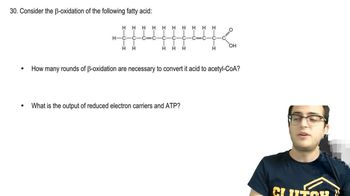
  • How many rounds of beta oxidation are required for an 11-carbon fatty acid?

    Four rounds of beta oxidation are necessary for an 11-carbon fatty acid.
  • How many acetyl CoA molecules are produced from the beta oxidation of an 11-carbon fatty acid?

    Four acetyl CoA molecules are produced directly from the process.
  • What happens to the remaining carbons after four rounds of beta oxidation in an 11-carbon fatty acid?

    The remaining carbons are released as propionyl CoA, which is converted to succinyl CoA.
  • How do double bonds in a fatty acid affect the production of reduced electron carriers during beta oxidation?

    Double bonds reduce the number of FADH2 produced; in this case, only 2 FADH2 are made instead of 4.
  • How many NADH molecules are produced during the beta oxidation of the 11-carbon fatty acid?

    Four NADH molecules are produced during the process.
  • How much ATP is generated from the FADH2 produced during beta oxidation and the citric acid cycle?

    A total of 6 ATP is generated from the 4 FADH2 produced in the citric acid cycle (1.5 ATP per FADH2).
  • How much ATP is generated from the NADH produced during the citric acid cycle?

    A total of 30 ATP is generated from the 12 NADH produced (2.5 ATP per NADH).
  • How many GTP (or ATP) molecules are produced from the acetyl CoA entering the citric acid cycle?

    Four GTP (or ATP) molecules are produced from the four acetyl CoA molecules.
  • What is the total ATP yield from the complete oxidation of the 11-carbon fatty acid, accounting for all steps?

    The total ATP yield is 52 ATP after subtracting 1 ATP used to produce succinyl CoA.
  • Why must 1 ATP be subtracted from the total ATP yield in this beta oxidation example?

    1 ATP is used to convert propionyl CoA to succinyl CoA, so it must be subtracted from the total.
  • What is the role of isomerase in the beta oxidation of unsaturated fatty acids?

    Isomerase is used to move double bonds into the correct position, but only when double bonds are adjacent.
  • How many FADH2 are produced directly from the beta oxidation of the 11-carbon fatty acid with two double bonds?

    Only 2 FADH2 are produced directly due to the presence of two double bonds.
  • What is the significance of CoA in the intermediate identified during beta oxidation?

    CoA is necessary for the intermediate to participate in beta oxidation and for the cleavage to yield acetyl CoA.