Pearson+ LogoPearson+ Logo

Glycolysis 1 quiz #2 Flashcards

Back
Glycolysis 1 quiz #2
Control buttons has been changed to "navigation" mode.
1/39
  • What is the end result of glycolysis?

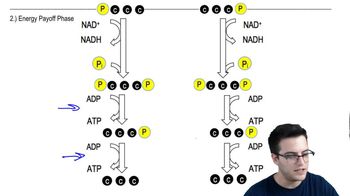
    The end result of glycolysis is the formation of 2 pyruvate molecules, 2 ATP (net), and 2 NADH per glucose.
  • Name an end product of glycolysis.

    An end product of glycolysis is pyruvate.
  • What is the energy investment phase of glycolysis?

    The energy investment phase is the initial phase of glycolysis where 2 ATP are consumed to phosphorylate glucose.
  • What is the product of glycolysis?

    The product of glycolysis is pyruvate.
  • What is the final product of glycolysis?

    The final product of glycolysis is pyruvate.
  • What is the net gain of ATP in glycolysis?

    The net gain is 2 ATP per glucose molecule.
  • What is the main function of glycolysis?

    The main function of glycolysis is to convert glucose into pyruvate and generate ATP and NADH.
  • What role does NADH play in glycolysis?

    NADH is produced during glycolysis and later used in cellular respiration to generate more ATP.
  • What does the process of glycolysis accomplish?

    Glycolysis breaks down glucose into pyruvate, producing ATP and NADH.
  • Glycolysis produces ATP through which process?

    Glycolysis produces ATP through substrate-level phosphorylation.
  • What is the substrate of glycolysis?

    The substrate of glycolysis is glucose.
  • What is the function of glycolysis?

    The function of glycolysis is to break down glucose into pyruvate and generate ATP and NADH.
  • What is the substrate for glycolysis?

    The substrate for glycolysis is glucose.
  • Which molecule initiates glycolysis?

    Glucose initiates glycolysis.
  • Which steps of glycolysis are irreversible?

    The irreversible steps are the phosphorylation of glucose to glucose-6-phosphate, phosphorylation of fructose-6-phosphate to fructose-1,6-bisphosphate, and conversion of phosphoenolpyruvate to pyruvate.
  • Glycolysis begins with which 6-carbon molecule?

    Glycolysis begins with glucose, a 6-carbon molecule.
  • What is the overall function of glycolysis?

    The overall function of glycolysis is to convert glucose into pyruvate and generate ATP and NADH.
  • How much ATP is produced in glycolysis per glucose molecule?

    A net gain of 2 ATP is produced per glucose molecule.
  • How much ATP is made during glycolysis?

    A net gain of 2 ATP is made during glycolysis per glucose molecule.
  • How much ATP does glycolysis make per glucose?

    Glycolysis makes a net gain of 2 ATP per glucose.
  • How many ATP are produced in glycolysis per glucose molecule?

    A net gain of 2 ATP are produced per glucose molecule.
  • How much ATP does glycolysis produce per glucose?

    Glycolysis produces a net gain of 2 ATP per glucose.
  • How many NADH are produced by glycolysis per glucose molecule?

    Glycolysis produces 2 NADH per glucose molecule.
  • What molecule is oxidized and broken down in glycolysis?

    Glucose is oxidized and broken down in glycolysis.
  • Which molecule from food is the primary reactant for glycolysis?

    Glucose is the primary reactant for glycolysis.
  • During glycolysis, glucose is broken down into which 3-carbon compound?

    Glucose is broken down into pyruvate, a 3-carbon compound.
  • Which additive prevents glycolysis?

    Additives that inhibit glycolytic enzymes, such as fluoride, can prevent glycolysis.
  • How many FADH2 are produced in glycolysis?

    No FADH2 is produced in glycolysis.
  • How much FADH2 is produced in glycolysis?

    Glycolysis does not produce FADH2.
  • How many NADH are produced in glycolysis per glucose?

    2 NADH are produced per glucose molecule.
  • Where does glycolysis take place in humans?

    Glycolysis takes place in the cytoplasm of human cells.
  • Where does glycolysis take place?

    Glycolysis takes place in the cytoplasm.
  • Where does the process of glycolysis occur?

    The process of glycolysis occurs in the cytoplasm.
  • Where does glycolysis occur in animal cells?

    Glycolysis occurs in the cytoplasm of animal cells.
  • What is the net profit of ATPs for glycolysis?

    The net profit is 2 ATP per glucose molecule.
  • Where does glycolysis happen?

    Glycolysis happens in the cytoplasm.
  • Where does the process of glycolysis take place?

    The process of glycolysis takes place in the cytoplasm.
  • Where does glycolysis occur in eukaryotic cells?

    Glycolysis occurs in the cytoplasm of eukaryotic cells.
  • In your body, where does glycolysis take place?

    In your body, glycolysis takes place in the cytoplasm of cells.