Pearson+ LogoPearson+ Logo

Introduction to Biosignaling quiz #1 Flashcards

Back
Introduction to Biosignaling quiz #1
Control buttons has been changed to "navigation" mode.
1/10
  • Which type of protein acts as a chemical messenger in biosignaling pathways?

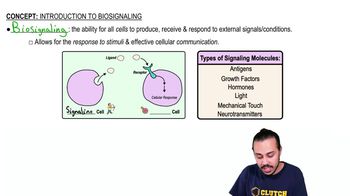
    Proteins that act as chemical messengers in biosignaling pathways are called ligands. These include hormones, growth factors, neurotransmitters, and other signaling molecules that bind to specific receptors on target cells to initiate a cellular response.
  • What is the role of a target cell in biosignaling?

    A target cell contains a specific receptor that binds to a signaling ligand. This binding initiates a cascade of intracellular events leading to a cellular response.
  • How does a receptor typically respond to ligand binding during signal transduction?

    Upon ligand binding, the receptor undergoes a conformational change. This change enables further intracellular signaling events to occur.
  • What does the dissociation equilibrium constant (Kd) represent in receptor-ligand interactions?

    Kd represents the equilibrium constant for the dissociation of the receptor-ligand complex. It is calculated as the concentration of free receptor and free ligand divided by the concentration of the receptor-ligand complex.
  • Which feature of biosignaling transduction systems allows a single receptor-ligand interaction to affect many downstream molecules?

    This feature is called amplification. It enables one receptor-ligand interaction to trigger multiple downstream signaling events.
  • How does modularity contribute to the versatility of biosignaling transduction systems?

    Modularity allows system components to be modified for different uses. This enables the same receptor-ligand interaction to produce varied cellular responses.
  • What is the significance of feedback regulation in biosignaling adaptation?

    Feedback regulation allows biosignaling systems to adapt to changing conditions. It can involve either positive or negative feedback to modulate the cellular response.
  • What is the main function of kinase enzymes in biosignaling pathways?

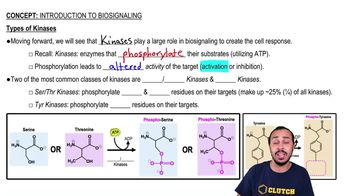
    Kinase enzymes phosphorylate target proteins by adding phosphate groups using ATP. This phosphorylation alters the activity of the target protein, either activating or inhibiting it.
  • Which amino acid residues are phosphorylated by serine/threonine kinases?

    Serine/threonine kinases phosphorylate serine and threonine residues on their target proteins. This modification can significantly change the protein's activity.
  • What are the three major categories of biosignaling pathways based on receptor type?

    The three major categories are pathways utilizing GPCRs, RTKs, and lipid hormone receptors. Each category has distinct mechanisms for transducing signals.