Back

Irreversible Inhibition definitions

Control buttons has been changed to "navigation" mode.
1/15
  • Irreversible Inhibition

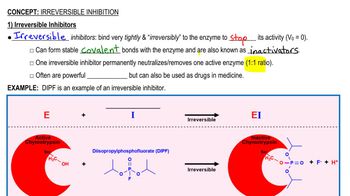
    Permanent loss of enzyme activity due to tight binding and formation of stable covalent bonds with inhibitors.
  • Irreversible Inhibitor

    Molecule that forms a strong, unbreakable bond with an enzyme, halting its function completely.
  • Inactivator

    Agent that neutralizes enzyme activity by forming a permanent, covalent bond with the enzyme.
  • Covalent Bond

    Chemical linkage responsible for the irreversible attachment of inhibitors to enzymes.
  • Enzyme Inhibitor Complex

    Stable structure formed when an inhibitor binds to a free enzyme, preventing its activity.
  • Enzyme Substrate Inhibitor Complex

    Irreversible assembly involving an enzyme, substrate, and inhibitor, resulting in loss of enzyme function.
  • DIPF

    Diisopropylphosphofluorate; a compound that covalently attaches to serine in chymotrypsin, inactivating the enzyme.
  • Chymotrypsin

    Protease enzyme whose activity is halted by covalent modification of its critical serine residue.
  • Serine Residue

    Amino acid in the active site of chymotrypsin essential for catalysis and targeted by DIPF.
  • Active Site

    Region of an enzyme where substrate binding and catalysis occur, often targeted by inhibitors.
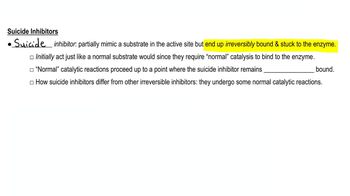
  • Suicide Inhibitor

    Special irreversible inhibitor that mimics a substrate and becomes covalently attached after normal catalysis.
  • Catalytic Reaction

    Process required by suicide inhibitors to achieve irreversible binding to the enzyme.
  • Substrate Mimic

    Characteristic of suicide inhibitors, allowing them to resemble and interact with enzyme substrates.
  • Reaction Velocity

    Rate of enzyme-catalyzed reaction, reduced to zero by irreversible inhibition.
  • One-to-One Ratio

    Relationship where each inhibitor molecule inactivates a single enzyme molecule permanently.