Back

Irreversible Inhibition quiz

Control buttons has been changed to "navigation" mode.
1/15
  • What is the main effect of irreversible inhibitors on enzyme activity?

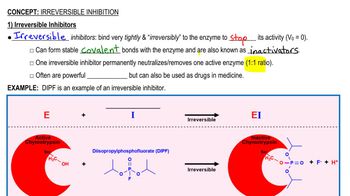
    Irreversible inhibitors completely halt enzyme activity by binding tightly and forming stable covalent bonds, reducing the enzyme's reaction velocity to zero.
  • What type of bond do irreversible inhibitors form with enzymes?

    Irreversible inhibitors form stable covalent bonds with enzymes, making the inhibition permanent.
  • What is another name for irreversible inhibitors?

    Irreversible inhibitors are also known as inactivators.
  • What is the ratio of irreversible inhibitor to active enzyme required for inactivation?

    The ratio is one irreversible inhibitor per one active enzyme, meaning a 1:1 ratio.
  • Can irreversible inhibitors bind to both free enzymes and enzyme-substrate complexes?

    Yes, irreversible inhibitors can bind to both free enzymes and enzyme-substrate complexes, forming irreversible complexes.
  • What is DIPF and what does it do?

    DIPF (diisopropylphosphofluorate) is an irreversible inhibitor that covalently binds to a critical serine residue in chymotrypsin, inactivating the enzyme.
  • Why are the bonds formed by irreversible inhibitors difficult to break?

    The bonds are stable covalent bonds, making them very difficult to break and thus irreversible.
  • What happens to chymotrypsin when DIPF binds to it?

    Chymotrypsin becomes inactive because DIPF covalently binds to its critical serine residue.
  • What is a suicide inhibitor?

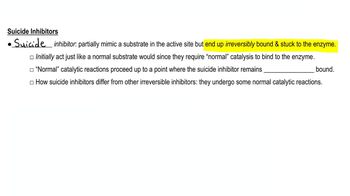
    A suicide inhibitor is a specific type of irreversible inhibitor that mimics a substrate and requires normal catalytic reactions to bind irreversibly to the enzyme.
  • How do suicide inhibitors initially interact with enzymes?

    Suicide inhibitors initially act like normal substrates and undergo normal catalytic reactions before becoming irreversibly bound.
  • How do suicide inhibitors differ from other irreversible inhibitors?

    Suicide inhibitors must undergo normal catalytic reactions to bind irreversibly, while other irreversible inhibitors do not require this step.
  • What is the directionality of the reaction between an irreversible inhibitor and an enzyme?

    The reaction is one-way, forming an irreversible complex without equilibrium arrows indicating reversibility.
  • Can irreversible inhibitors be used as drugs in medicine?

    Yes, despite often being powerful poisons, irreversible inhibitors can also be used as drugs in medicine.
  • What is the critical amino acid residue in chymotrypsin targeted by DIPF?

    The critical amino acid residue is serine, which is essential for chymotrypsin's catalytic activity.
  • What is the ultimate outcome for an enzyme after binding an irreversible inhibitor?

    The enzyme becomes permanently inactivated and cannot regain activity.