Back

Km Enzyme quiz

Control buttons has been changed to "navigation" mode.
1/15
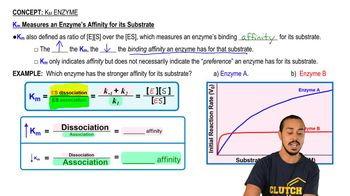
  • What is the Michaelis constant (Km) in enzyme kinetics?

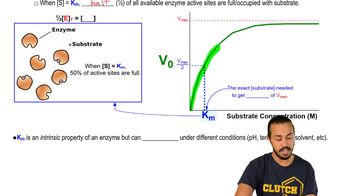
    Km is the substrate concentration at which the initial reaction velocity is exactly half of the maximum velocity (Vmax).
  • How is Km related to enzyme active site occupancy?

    When substrate concentration equals Km, exactly half of the enzyme's active sites are occupied by substrate.
  • Does Km change with the amount of enzyme present?

    No, Km is an intrinsic property of the enzyme and does not change with enzyme concentration.
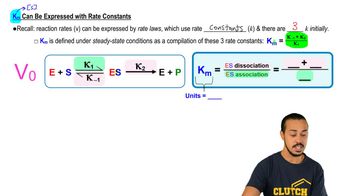
  • How can Km be expressed in terms of rate constants?

    Km can be expressed as (k-1 + k2) / k1, where k-1 and k2 are dissociation rate constants and k1 is the association rate constant.
  • What does a high Km value indicate about enzyme-substrate affinity?

    A high Km value indicates a low affinity of the enzyme for its substrate.
  • What does a low Km value indicate about enzyme-substrate affinity?

    A low Km value indicates a high affinity of the enzyme for its substrate.
  • What are the units of Km?

    Km has units of substrate concentration, typically molarity (M).
  • How does changing pH or temperature affect Km?

    Km can vary with changes in pH, temperature, or solvent conditions.
  • What is the relationship between Km and enzyme efficiency?

    Km helps measure enzyme efficiency and substrate affinity, with lower Km indicating higher efficiency.
  • How is Km used in enzyme inhibitor studies?

    Km is used to understand how inhibitors affect enzyme behavior and substrate binding.
  • What is the significance of the ratio (k-1 + k2) / k1 in defining Km?

    This ratio represents the sum of dissociation rates over the association rate, defining Km under steady-state conditions.
  • How does doubling enzyme concentration affect Km?

    Doubling enzyme concentration does not affect Km; it remains constant.
  • What happens to Vmax and initial velocity when enzyme concentration increases?

    Both Vmax and initial velocity increase with higher enzyme concentration, but Km stays the same.
  • How can Km be expressed using concentrations of enzyme and substrate?

    Km can be expressed as [E][S]/[ES], the ratio of free enzyme and substrate to the enzyme-substrate complex.
  • Why must Km be defined as dissociation over association rate constants?

    If the ratio were reversed, the units would not be concentration, so Km must be dissociation over association to retain units of molarity.