Back

Lock and Key Vs. Induced Fit Models definitions

Control buttons has been changed to "navigation" mode.
1/15
  • Active Site

    Region on an enzyme with a shape that interacts with the substrate, either rigid or adjustable depending on the model.
  • Enzyme

    Biological catalyst that interacts with substrates to speed up reactions by lowering the energy of activation.
  • Substrate

    Molecule that binds to an enzyme's active site, forming a complex and undergoing a chemical reaction.
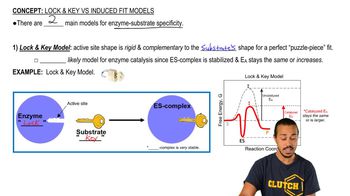
  • Enzyme-Substrate Complex

    Temporary association between enzyme and substrate, whose stability varies between models.
  • Lock and Key Model

    Theory where the active site is rigid and perfectly matches the substrate, leading to a highly stable complex.
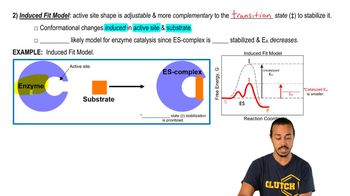
  • Induced Fit Model

    Theory where the active site adjusts its shape to better fit the transition state, allowing conformational changes.
  • Transition State

    High-energy intermediate during a reaction, whose stabilization is prioritized in the induced fit model.
  • Conformational Change

    Alteration in the shape of the enzyme or substrate upon complex formation, crucial in the induced fit model.
  • Energy of Activation

    Minimum energy required for a reaction, decreased by enzymes in the induced fit model.
  • Catalysis

    Process by which enzymes accelerate reactions, typically by lowering the energy of activation.
  • Specificity

    Ability of an enzyme to selectively interact with a particular substrate, explained by both models.
  • Complementarity

    Degree to which the shapes of the active site and substrate or transition state match each other.
  • Reaction Coordinate

    Axis representing the progress of a chemical reaction, used in energy diagrams.
  • Uncatalyzed Reaction

    Chemical process occurring without enzyme involvement, typically with higher energy of activation.
  • Stabilization

    Reduction in energy of a complex or transition state, affecting reaction speed and likelihood.