Back

Mass Spectrometry quiz

Control buttons has been changed to "navigation" mode.
1/15
  • What does mass spectrometry (MS) separate molecules based on?

    Mass spectrometry separates molecules based on their mass-to-charge (m/z) ratios.
  • In mass spectrometry, what does the 'z' in the m/z ratio usually represent?

    The 'z' represents the charge of the ion, which is usually equal to 1.
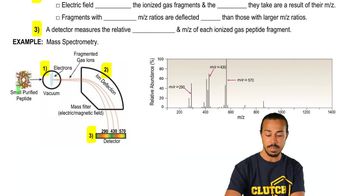
  • What are the three main steps in the operation of a mass spectrometer?

    The three main steps are ionization, deflection in an electric/magnetic field, and detection.
  • How is a purified peptide prepared for mass spectrometry in the first step?

    It is converted into a gas and ionized, typically by bombardment with electrons or a noble gas.
  • What typically happens to the peptide during the ionization step?

    The peptide is fragmented, often breaking peptide bonds to create smaller ionized fragments.
  • How does the electric or magnetic field affect ionized fragments in mass spectrometry?

    It deflects the ionized fragments, with the degree of deflection depending on their m/z ratios.
  • Which fragments are deflected more in the mass spectrometer: those with smaller or larger m/z ratios?

    Fragments with smaller m/z ratios are deflected more than those with larger m/z ratios.
  • What does the detector in a mass spectrometer measure?

    The detector measures the abundance and m/z ratio of each ionized fragment.
  • What is a mass spectrum?

    A mass spectrum is a data plot showing the relative abundance of detected fragments (y-axis) versus their m/z ratios (x-axis).
  • What do the peaks in a mass spectrum represent?

    Each peak represents a different ionized gas peptide fragment.
  • How does the m/z axis in peptide mass spectrometry compare to that of small organic molecules?

    The m/z axis for peptides is much larger, reflecting the greater mass and complexity of peptide fragments.
  • Why do peptide fragments have higher m/z ratios than small organic molecules?

    Peptide fragments contain more atoms and thus have greater mass, resulting in higher m/z ratios.
  • What is the typical range of m/z values for peptide mass spectrometry shown in the example?

    The m/z values range from about 200 to 1400.
  • Why is the m/z ratio often considered just the mass of the molecule in mass spectrometry?

    Because the charge (z) is usually 1, so the m/z ratio numerically equals the mass.
  • What information can be obtained from the mass spectrum of a peptide?

    The mass spectrum provides the relative abundance and m/z ratios of the peptide fragments, which can be used to deduce structural and chemical information.