Back

Membrane Structure 1 quiz

Control buttons has been changed to "navigation" mode.
1/15
  • What are the two main components of biological membranes?

    Proteins and phospholipids are the two main components of biological membranes.
  • What role does cholesterol play in the plasma membrane?

    Cholesterol fills gaps between fatty acids in the membrane, decreasing membrane fluidity and increasing structural integrity.
  • How do phospholipids typically move within the membrane?

    Phospholipids move laterally within the same monolayer but rarely flip-flop between layers without enzyme assistance.
  • Which enzymes are responsible for moving phospholipids between membrane monolayers?

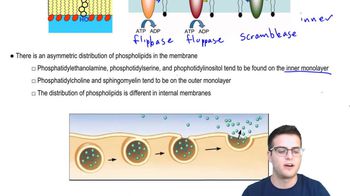
    Flippase, flopase, and scramblase are enzymes that move phospholipids between membrane monolayers.
  • What is meant by the asymmetric distribution of phospholipids in membranes?

    Asymmetric distribution means certain phospholipids are more concentrated in one monolayer than the other, such as phosphatidylcholine on the outer layer and phosphatidylserine on the inner layer.
  • Which phospholipids are primarily found on the inner monolayer of the plasma membrane?

    Phosphatidylethanolamine, phosphatidylserine, and phosphatidylinositol are mainly found on the inner monolayer.
  • Which phospholipids are mainly found on the outer monolayer of the plasma membrane?

    Phosphatidylcholine and sphingomyelin are mainly found on the outer monolayer.
  • How does the distribution of phospholipids differ between plasma membranes and internal membranes?

    Internal membranes often have an opposite distribution of phospholipids compared to the plasma membrane due to their interactions during vesicle formation and fusion.
  • Why do organisms living at higher temperatures have more saturated fatty acids in their membranes?

    Saturated fatty acids increase membrane rigidity, preventing the membrane from becoming too fluid and falling apart at high temperatures.
  • Why do organisms in colder environments have more unsaturated fatty acids in their membranes?

    Unsaturated fatty acids keep membranes more fluid at low temperatures, preventing them from hardening into a crystalline structure.
  • What are lipid rafts and what are they composed of?

    Lipid rafts are dense microdomains in the membrane, rich in sphingolipids and cholesterol.
  • What is the fluid mosaic model of membranes?

    The fluid mosaic model describes membranes as dynamic structures with proteins and lipids moving laterally, allowing flexibility and diverse functions.
  • How do vesicle formation and membrane fusion relate to membrane lipid distribution?

    Vesicle formation and fusion involve the merging or budding of membranes, which helps explain the opposite phospholipid distributions in internal and plasma membranes.
  • What effect does cholesterol have on membrane fluidity?

    Cholesterol decreases membrane fluidity by filling gaps between fatty acids, making the membrane more rigid.
  • Why is membrane fluidity important for cellular function?

    Membrane fluidity is essential for processes like vesicle formation, membrane fusion, and proper protein function within the membrane.