Back

Membrane Structure 2 quiz

Control buttons has been changed to "navigation" mode.
1/15
  • How many types of membrane proteins are there?

    There are six types of membrane proteins.
  • Name three general functions of membrane proteins.

    Membrane proteins function as receptors, transport channels/gates/pumps, and enzymes.
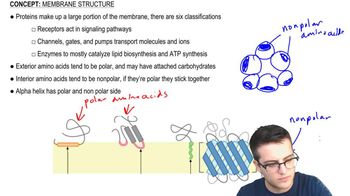
  • What type of amino acids are typically found on the exterior of membrane proteins?

    Polar amino acids are typically found on the exterior of membrane proteins.
  • Why are exterior amino acids of membrane proteins often polar?

    They interact with the aqueous environment surrounding the membrane.
  • What type of amino acids are found in the interior of membrane proteins embedded in the membrane?

    Non-polar amino acids are found in the interior of membrane proteins.
  • How do alpha helices in membrane proteins display polarity?

    Alpha helices have alternating polar and non-polar sides, with non-polar sides interacting with the membrane.
  • What is the significance of alternating polar and non-polar amino acids in alpha helices?

    It allows the protein to interact appropriately with both the membrane and the aqueous environment.
  • Can phospholipids associate with both the interior and exterior surfaces of membrane proteins?

    Yes, phospholipids can associate with both the interior and exterior surfaces of membrane proteins.
  • What is the hydropathy index used for?

    The hydropathy index is used to determine hydrophobic and hydrophilic regions of proteins.
  • What does a positive hydropathy index value indicate?

    A positive value indicates a hydrophobic (water-repelling) region.
  • What does a negative hydropathy index value indicate?

    A negative value indicates a hydrophilic (water-attracting) region.
  • Where are hydrophobic regions of a membrane protein likely to be found?

    Hydrophobic regions are likely to be found in the internal part of the membrane.
  • Where are hydrophilic regions of a membrane protein likely to be found?

    Hydrophilic regions are likely to be found on the external surfaces, interacting with water.
  • Which two amino acids are commonly found at the edge of the membrane in transmembrane proteins?

    Tryptophan and tyrosine are commonly found at the edge of the membrane.
  • How are peripheral proteins attached to the membrane?

    Peripheral proteins are attached to fatty acids embedded in the membrane.