Back

Membrane Transport 3 definitions

Control buttons has been changed to "navigation" mode.
1/12
  • Ionophore

    Molecule that enables ions to cross membranes, often disrupting cellular ion gradients and typically acting as a toxin.
  • Electrochemical Gradient

    Difference in ion concentration and charge across a membrane, crucial for cellular transport and energy processes.
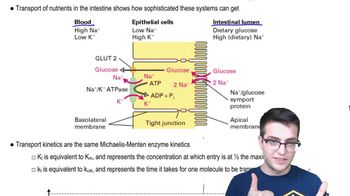
  • Intestinal Lumen

    Internal space of the intestine where nutrient absorption begins, characterized by high sodium concentration.
  • Sodium-Glucose Importer

    Transporter that co-moves sodium and glucose into cells, exploiting the sodium gradient for nutrient uptake.
  • Sodium-Potassium Pump

    Membrane protein that actively expels sodium and brings in potassium, maintaining low intracellular sodium levels.
  • NaK ATPase

    Enzyme responsible for pumping sodium out and potassium into cells, using ATP to sustain ion gradients.
  • Facilitated Diffusion

    Process where molecules move across membranes via specific proteins, without energy input, following concentration gradients.
  • Secondary Active Transport

    Mechanism where transport of one molecule is coupled to the movement of another, using existing gradients for energy.
  • Transport Kinetics

    Study of how solute concentration affects the rate of movement across membranes, analogous to enzyme kinetics.
  • Solute Concentration

    Amount of dissolved particles in a solution, influencing the rate of membrane transport.
  • Kt

    Value representing the solute concentration at which transport rate reaches half its maximum, similar to Km in enzymes.
  • Lower Kt

    Parameter indicating the time required for a single solute molecule to be transported, analogous to kcat in enzymes.