Back

Membrane Transport 3 quiz

Control buttons has been changed to "navigation" mode.
1/15
  • What are ionophores and what is their main function in membranes?

    Ionophores are molecules that facilitate ion transport across membranes by either binding and moving ions or forming pores that allow ions to pass.
  • Why are most ionophores considered toxins to cells?

    Most ionophores are toxins because they disrupt the cell's carefully maintained ion gradients by allowing uncontrolled ion movement.
  • What is the main purpose of ion pumps in cells?

    Ion pumps establish and maintain specific electrochemical gradients across cell membranes.
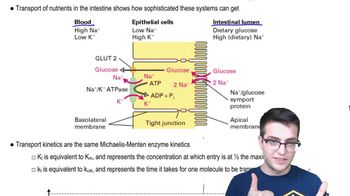
  • How do cells in the digestive tract demonstrate sophisticated transport mechanisms?

    They use different transporters on the intestinal lumen and blood-facing sides to absorb nutrients efficiently.
  • What is the role of the sodium-glucose importer in intestinal cells?

    It co-transports glucose into the cell by exploiting the sodium gradient, moving sodium down its electrochemical gradient.
  • How does the sodium-potassium pump (NaK ATPase) contribute to nutrient absorption in intestinal cells?

    It actively pumps sodium out of the cell to maintain a low internal sodium concentration, supporting the sodium-glucose co-transport.
  • After glucose enters the intestinal cell, how does it exit into the blood?

    Glucose exits the cell through facilitated diffusion.
  • What type of transport is used by the sodium-glucose importer?

    It uses secondary active transport.
  • What is the analogy between transport kinetics and enzyme kinetics?

    Transport kinetics are analogous to enzyme kinetics, with solute concentration affecting the rate of solute entry similar to substrate concentration in enzyme reactions.
  • In transport kinetics, what does 'kt' represent?

    Kt is the solute concentration at which the rate of solute entry is half its maximum.
  • How is 'kt' in transport kinetics similar to 'km' in enzyme kinetics?

    Both represent the concentration at which the rate reaches half of its maximum value.
  • What does 'lower kt' refer to in transport kinetics?

    Lower kt is analogous to kcat in enzyme kinetics and represents the time it takes for one molecule of solute to be transported.
  • Why is the placement of transporters on different sides of intestinal cells important?

    Proper placement ensures efficient absorption of nutrients like glucose; without it, nutrient absorption would fail.
  • What happens if the transport mechanisms in intestinal cells do not function properly?

    The body would be unable to absorb glucose, leading to a lack of energy for cells and potentially fatal consequences.
  • Why is understanding transport kinetics considered straightforward for students familiar with enzyme kinetics?

    Because the principles and graphical representations are nearly identical, with only terminology changes.