Back

Metabolic Regulation 1 definitions

Control buttons has been changed to "navigation" mode.
1/15
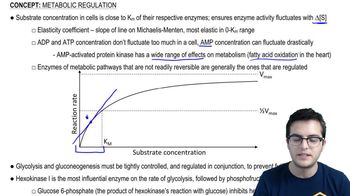
  • Substrate Concentration

    Cellular levels of reactants that influence enzyme activity, especially near the Km, allowing sensitive metabolic regulation.
  • Km

    A value representing the substrate concentration at which an enzyme operates at half its maximum velocity, crucial for regulatory sensitivity.
  • Elasticity Coefficient

    A measure of how responsive enzyme activity is to changes in substrate concentration, highest near the Km.
  • AMP

    A nucleotide whose cellular concentration fluctuates widely, serving as a primary indicator of energy status.
  • ADP

    A nucleotide with relatively stable cellular levels, less sensitive as an energy status indicator compared to AMP.
  • ATP

    A nucleotide with stable concentration in cells, representing the main energy currency but not a dynamic regulatory signal.
  • AMP-Activated Protein Kinase

    A metabolic sensor that detects AMP changes and triggers broad effects on cellular metabolism.
  • Glycolysis

    A metabolic pathway tightly regulated to prevent energy-wasting cycles, initiated by hexokinase 1.
  • Gluconeogenesis

    A metabolic pathway requiring strict control to avoid futile cycling with glycolysis.
  • Hexokinase 1

    The most influential enzyme in glycolysis, inhibited by its product, glucose 6-phosphate.
  • Glucose 6-Phosphate

    A molecule that inhibits hexokinase 1, regulating glycolysis and produced by both hexokinase and glucokinase.
  • Glucokinase

    An isozyme found only in liver cells, with a higher Km and not inhibited by glucose 6-phosphate.
  • Isozyme

    A variant of an enzyme, such as glucokinase, differing in regulatory properties and tissue distribution.
  • Reaction Velocity

    The rate at which an enzyme catalyzes a reaction, influenced by substrate concentration and enzyme properties.
  • Futile Cycle

    A process where opposing metabolic pathways run simultaneously, wasting cellular energy.