Back

Mixed Inhibition quiz

Control buttons has been changed to "navigation" mode.
1/15
  • What is mixed inhibition in enzyme kinetics?

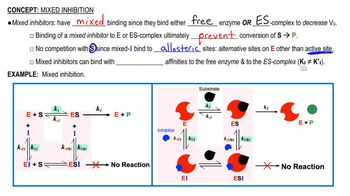
    Mixed inhibition occurs when an inhibitor binds to both the free enzyme and the enzyme-substrate complex at allosteric sites, affecting enzyme activity.
  • How does mixed inhibition differ from competitive inhibition?

    Mixed inhibitors bind to allosteric sites, not the active site, and do not compete with the substrate for binding, unlike competitive inhibitors.
  • What effect do mixed inhibitors have on the initial reaction velocity (v₀)?

    Mixed inhibitors always decrease the initial reaction velocity of an enzyme-catalyzed reaction.
  • What are the inhibition constants Ki and Ki' in mixed inhibition?

    Ki is the inhibition constant for the free enzyme, and Ki' is for the enzyme-substrate complex; in mixed inhibition, Ki ≠ Ki'.
  • What happens to the apparent Vmax in the presence of mixed inhibitors?

    The apparent Vmax always decreases when mixed inhibitors are present.
  • How can mixed inhibitors affect the apparent Km?

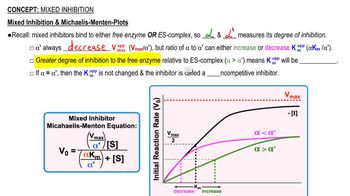
    Mixed inhibitors can either increase or decrease the apparent Km, depending on their relative affinities for the free enzyme and the enzyme-substrate complex.
  • What principle explains the changes in Km caused by mixed inhibitors?

    Le Chatelier's principle explains whether Km increases or decreases based on the degree of inhibition (alpha and alpha prime).
  • What does it mean if alpha is greater than alpha prime in mixed inhibition?

    If alpha > alpha prime, the inhibitor has a stronger affinity for the free enzyme, causing an increase in apparent Km.
  • What does it mean if alpha is less than alpha prime in mixed inhibition?

    If alpha < alpha prime, the inhibitor has a stronger affinity for the enzyme-substrate complex, causing a decrease in apparent Km.
  • Why can't the substrate outcompete a mixed inhibitor?

    Because mixed inhibitors bind to allosteric sites and do not compete with the substrate for the active site, the substrate cannot outcompete them.
  • How does mixed inhibition affect the catalytic constant (kcat or turnover number)?

    Mixed inhibition decreases the catalytic constant (kcat) because Vmax is decreased while total enzyme concentration remains unchanged.
  • How is the Michaelis-Menten equation modified in the presence of mixed inhibitors?

    The equation uses apparent Vmax (Vmax/alpha prime) and apparent Km (alpha/alpha prime × Km) to reflect the effects of mixed inhibition.
  • What is the effect of mixed inhibitors on the Michaelis-Menten plot?

    Mixed inhibitors decrease the initial reaction velocity and Vmax, and can either increase or decrease Km, altering the curve shape.
  • How do mixed inhibitors affect the Lineweaver-Burk plot?

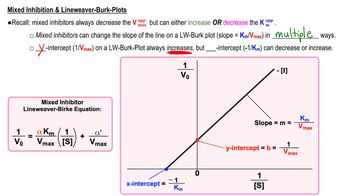
    Mixed inhibitors always increase the y-intercept (1/Vmax) and can shift the x-intercept (−1/Km) either closer to or further from zero, depending on Km changes.
  • What distinguishes mixed inhibition from noncompetitive inhibition?

    In mixed inhibition, Ki ≠ Ki', while in noncompetitive inhibition, Ki = Ki', resulting in no change in Km.