What are myofibrils composed of, and what roles do actin and myosin play in muscle contraction?
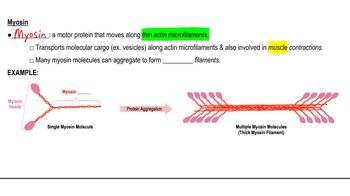
Myofibrils are composed of protein filaments called actin (thin filaments) and myosin (thick filaments). Myosin is a motor protein that moves along actin microfilaments, using ATP to generate the force necessary for muscle contraction.
What are the three main components of the cytoskeleton that motor proteins interact with?
The cytoskeleton consists of microfilaments, intermediate filaments, and microtubules. Motor proteins interact with microfilaments and microtubules to generate movement.
Which motor protein is responsible for moving molecular cargo along actin microfilaments?
Myosin is the motor protein that moves molecular cargo along actin microfilaments. It transports vesicles and is also involved in muscle contraction.
How do multiple myosin molecules organize to form a structural feature in muscle cells?
Multiple myosin molecules aggregate to form thick filaments. These thick filaments are essential for muscle contraction.
What is the direction of kinesin movement along microtubules, and what does it transport?
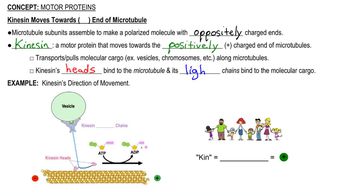
Kinesin moves toward the positively charged end of microtubules. It transports molecular cargo such as vesicles and chromosomes.
What structural feature of microtubules allows kinesin and dynein to move in opposite directions?
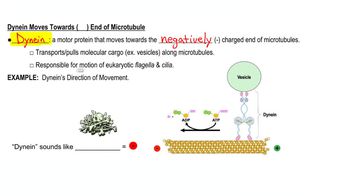
Microtubules are polarized molecules with oppositely charged ends. This polarity enables kinesin to move toward the positive end and dynein toward the negative end.
Which motor protein is responsible for the movement of eukaryotic flagella and cilia?
Dynein is responsible for the movement of eukaryotic flagella and cilia. It moves toward the negatively charged end of microtubules.
What energy source do motor proteins use to generate movement along cytoskeletal tracks?
Motor proteins use ATP as their energy source. ATP hydrolysis powers their movement along cytoskeletal tracks.
How do the heads and tails of myosin contribute to its function?
The myosin heads bind to actin filaments and hydrolyze ATP to generate movement. The tails allow myosin molecules to aggregate into thick filaments.
What mnemonic can help you remember the direction of dynein movement along microtubules?
Dynein sounds like 'dying,' which is associated with negativity. This helps remember that dynein moves toward the negatively charged end of microtubules.